That gap is the opportunity.
This article breaks down how PE sponsors and operating partners can use procurement as a high-leverage EBITDA growth tool — from due diligence through exit — covering the three core levers, cross-portfolio aggregation, capability building, and how to make savings stick.
Key Takeaways
- A dollar saved in procurement flows almost directly to EBITDA — unlike revenue, it bypasses margin entirely
- Coordinated PE procurement programs manage ~80% of third-party spend vs. 60% for uncoordinated firms — a gap widening 6–10% annually
- Procurement engagement should start at due diligence, not after close — the first 3–6 months post-acquisition are the highest-risk period for value delay
- Cross-portfolio aggregation is the structural advantage most PE firms systematically under-exploit
- Savings erode without compliance monitoring: governance infrastructure matters as much as the initial sourcing win
The EBITDA Case for Procurement as a Value Creation Lever
Why Procurement Beats Revenue Growth on a Dollar-for-Dollar Basis
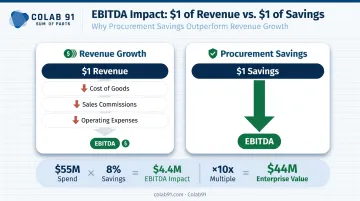
Revenue growth is great. But a dollar of new revenue passes through cost of goods, sales commissions, and operating expenses before it reaches EBITDA. A dollar saved in procurement? It lands almost entirely in EBITDA.
Here's a concrete illustration. Take a portfolio company with:
- $100M revenue
- $12M EBITDA (12% margin)
- $55M in third-party spend
A procurement savings program targeting 8% of that addressable spend generates $4.4M in run-rate savings. At a 10x EBITDA exit multiple, that's $44M in enterprise value — from a sourcing program, not an acquisition.
Alvarez & Marsal reports that indirect procurement savings alone can uplift EBITDA by 0.4 to 2.0 percentage points, with up to 20% of savings realizable within the first 100 days post-close and up to 70% in year one. For a fund under pressure to show EBITDA improvement ahead of exit, year-one capture at that scale is material to the investment thesis.
The Inflation Tailwind Procurement Programs Can Capture
Post-pandemic supplier pricing has reset permanently upward across most spend categories. The BLS Producer Price Index for final demand rose roughly 33% between January 2020 and mid-2026, and the ISM Services Prices Index sat at 71.3% in May 2026 — services prices had increased for 108 consecutive months.
Manufacturing input costs showed no relief either, with 66.3% of respondents in the same period reporting paying higher prices.
Supplier contracts signed before 2022 may be significantly below market on the upside, while contracts signed during peak inflation years may now be over-market as supplier costs normalize. Both represent renegotiation opportunities.
Why Procurement Stays Underutilized in PE Portfolios
Despite the math, procurement consistently gets deprioritized. The reasons are predictable:
- No spend visibility at acquisition — fragmented ERP data, no spend cube, no category ownership
- Thin procurement resources at the portfolio company level — often a transactional purchasing team, not a strategic function
- Perceived complexity of coordinating across legally separate entities
- Reluctance to mandate operational decisions to management teams protecting autonomy
The result: most PE firms offer selective procurement support through generalist operating partners on a case-by-case basis, a pattern Kearney documented as recently as 2019 that hasn't changed materially for smaller and mid-market funds.
These internal barriers have real consequences when exit timing tightens.
The Exit Window Context
Timing matters more than most operating partners acknowledge. Bain reports a $3.6 trillion exit backlog across approximately 29,000 unsold companies, with buyout funds holding nearly double the assets they held in 2019. Many assets acquired between 2018–2021 are now approaching exit-readiness in a market where buyers scrutinize cost structures closely.
A clean, documented procurement savings program — with run-rate EBITDA improvement validated by spend analytics — is a meaningful differentiator in a crowded exit pipeline.
Key Procurement Levers PE Firms Pull to Drive Portfolio Growth
PE firms that consistently outperform on EBITDA don't treat procurement as a single initiative. They pull three levers in coordination — and the sequence matters less than the simultaneity.
Lever 1: Strategic Sourcing and Third-Party Cost Reduction
The highest-impact lever is systematic renegotiation and rebidding of major spend categories. The counterintuitive starting point: indirect spend, not direct. IT software and hardware, contingent labor, freight, facilities management, professional services, and utilities are frequently negotiated ad hoc, lack competitive tension, and carry pricing that hasn't been benchmarked in years.
A rapid spend diagnostic — typically 4–6 weeks — surfaces a prioritized list of sourcing opportunities with clear business cases. Colab91's Savings Opportunity Assessment, for example, delivers a category-by-category attack plan within that window, identifying 5–15% of addressable spend as recoverable savings.
Key characteristics of high-yield indirect categories:
- High supplier fragmentation with consolidation potential
- Long-standing contracts without renegotiation triggers
- Spend that crosses multiple business units without central ownership
- Categories where market pricing has moved significantly since last contract date
Targeting even 50–60% of addressable indirect spend through focused sourcing events drives real EBITDA improvement — without touching the product, the customer, or the revenue model.
Lever 2: Procurement Process Maturity
A sourcing win without governance infrastructure is temporary. For a typical mid-market portfolio company that lacks a formal procurement function, maturity means building from scratch:
- Category management — moving from ad hoc purchasing to structured ownership by spend category
- Contract compliance — tracking whether spend is flowing through negotiated agreements
- Supplier performance management — regular reviews with accountability mechanisms
- Spend analytics — continuous visibility rather than annual reviews
The Hackett Group's research quantifies what this gap costs: Digital World Class procurement organizations deliver nearly double the spend cost reduction of their peers and generate 2.5x higher ROI. The maturity gap between best and average performers is not marginal.
Beyond cost reduction, procurement maturity creates the process discipline that sustains savings and manages supplier risk over time. For buy-and-build strategies specifically, that foundation pays an additional dividend: when a new add-on acquisition joins the platform, a mature procurement function absorbs and rationalizes that spend quickly — rather than starting from zero each time.
Lever 3: GPOs and Purchasing Consortia
Group Purchasing Organizations give small and mid-market portfolio companies access to pre-negotiated contracts at enterprise-level pricing without dedicated internal procurement resources. For common spend categories — office supplies, fleet, MRO, certain IT hardware categories — GPOs remove the need for full competitive sourcing events.
More than 300 private equity firms already use GPO models according to OMNIA Partners, which manages collective buying power exceeding $30 billion. The practical value: new portfolio company acquisitions can access pricing on day one, before the internal procurement program is built.
GPOs work best when:
- Specifications are largely standardized across portfolio companies
- Internal procurement bandwidth is constrained
- Speed of implementation matters more than maximum savings optimization
- Categories are commodity-like with established market pricing benchmarks
Cross-Portfolio Procurement: Unlocking Economies of Scale
PE firms function as a de facto parent company across their portfolio. That structure creates a purchasing aggregation opportunity that standalone companies — and most competitors — simply cannot replicate.
Identifying Cross-Portfolio Opportunities
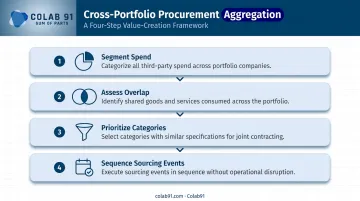
The methodology is straightforward in concept, harder in execution:
- Segment all third-party spend across portfolio companies by category
- Assess overlap in goods and services consumed
- Prioritize categories where specifications are similar enough to enable joint contracting
- Sequence sourcing events to capture savings without disrupting operations
High-priority categories for cross-portfolio sourcing typically include IT licenses and SaaS subscriptions, cloud services, travel and expense programs, insurance, telecom, and commodity materials where volume aggregation directly drives price.
Kearney's analysis shows coordinated procurement leaders generate approximately $100M in annual savings on a $2B spend base — creating a $50M performance gap versus uncoordinated firms. The procurement performance gap widened 39% between 2020 and 2025 and continues to accelerate.
Organizational Requirements and Implementation Realities
Effective cross-portfolio procurement requires a dedicated, lean procurement function at the fund level — or a trusted external partner who can execute across multiple portfolio companies simultaneously.
Some leading PE houses have built "plug and play" contract frameworks that new acquisitions can onboard quickly, compressing the time-to-value window for add-ons.
Three implementation challenges consistently surface:
- Suppliers push back on group discounts across different legal entities
- Specification differences limit true aggregation in several categories
- Portfolio company leadership may view cross-portfolio programs as interference rather than support
The most effective framing: position cross-portfolio procurement as optional value-add with savings tied directly to each portfolio company's P&L. Leadership teams move faster when the financial upside is theirs to keep.
Timing Is Everything: When to Engage the Procurement Lever
Start at Due Diligence
Best practice is procurement engagement before close, not after. Bringing procurement expertise into the due diligence phase allows teams to build a savings pipeline ready to execute from day one — rather than losing the first 3–6 months post-close to baseline analysis. McKinsey recommends involving the operating group during diligence to develop the value creation thesis, not after it's been committed to investors.
Kearney notes that AI-enabled cross-portfolio analytics can provide portfolio-level spend visibility in weeks rather than months, with run-rate savings achievable within 90 to 180 days of the hold period — but only if the groundwork starts early.
The Rapid Spend Assessment: First 4–6 Weeks Post-Close
If diligence engagement wasn't possible, the rapid spend assessment becomes the immediate priority post-acquisition. A structured 4–6 week process should deliver:
- Spend cube construction — cleansed, categorized data across all spend categories
- Benchmark pricing analysis — current pricing versus market standards
- An addressable spend map showing what percentage of total spend can be competitively sourced
- Prioritized savings roadmap — initiatives ranked by savings potential, effort, and timeline
- Quick wins flagged for execution within the first 100 days
Executive Sponsorship Is Non-Negotiable
Procurement programs without executive sponsorship fail consistently. The CFO, COO, or CEO must own savings targets alongside procurement — not just endorse them. Without that accountability, the pattern is predictable:
- Spend owners across functions delay sourcing decisions
- Competitive events stall waiting for internal alignment
- Savings land late — or not at all — on the P&L
The procurement lever only works when senior leadership pulls it alongside the team, not from the sideline.
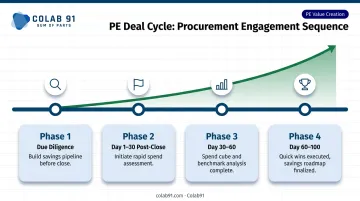
Timing determines whether procurement becomes a true value creation engine during the hold period or an afterthought that scrambles to catch up at exit.
Building Procurement Capability in PE Portfolio Companies
The Root Capability Gap
Most mid-market portfolio companies either lack a dedicated procurement function entirely or operate with a transactional purchasing team focused on order management rather than strategic sourcing. PE operating partners typically lack the bandwidth to fill this gap themselves across a full portfolio — and the depth of domain expertise required varies significantly by spend category.
The capability gap is usually a combination of:
- Headcount — not enough people to manage the category scope
- Skills — transactional buyers who lack RFP design, negotiation, and supplier analytics capabilities
- Tools — no spend analytics platform, no contract repository, no performance dashboards
Choosing the Right Capability Model
Three models dominate PE portfolio procurement build-outs:
| Model | Speed | Cost | Capability Depth | Risk |
|---|---|---|---|---|
| Hire full-time CPO / team | Slow (6–12 months) | High | High | Execution depends on talent found |
| Management consulting | Fast to insight | Very High | Shallow (insight, not execution) | Savings not sustained post-engagement |
| Offshore capability center | Fast (weeks) | Moderate | High + scalable | Requires effective onshore governance |
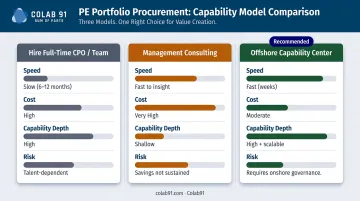
The blended model — onshore strategic leadership paired with offshore analytical and execution capacity — is what the most effective PE-backed procurement transformations use. It preserves strategic control while cutting time-to-savings from months to weeks.
Colab91 applies this model directly. The firm builds India-based procurement capability centers for PE-backed and mid-market companies, combining strategic sourcing domain expertise with AI-powered spend analytics. Engagement structures range from dedicated team builds to build-operate-transfer models, depending on the PE firm's timeline and ownership preferences. Colab91's leadership team previously scaled a 100+ practitioner offshore procurement organization serving Carlyle Group, TPG, Elliott, and BC Partners.
Making Savings Stick: Sustaining Procurement Value Through the Hold Period
Why Savings Erode Without Governance
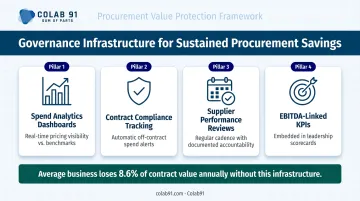
One-time sourcing wins are common. Sustained savings are not. Without ongoing contract compliance monitoring and supplier management, prices creep back up — off-contract spending reappears, renegotiated terms go unenforced, and suppliers quietly revert to prior pricing structures.
World Commerce & Contracting reports the average business loses 8.6% of contract value annually through poor contract management — with worst performers losing 15% or more. For a portfolio company with $50M in third-party spend, that's $4.3M in annual leakage, simply from insufficient post-award oversight.
The Infrastructure Required to Sustain Savings
Procurement programs that hold through the exit process share several structural characteristics:
- Spend analytics dashboards providing real-time pricing visibility versus benchmarks
- Contract compliance tracking that flags off-contract spend automatically
- Supplier performance reviews on a regular cadence with documented accountability
- KPIs tied to EBITDA — not just procurement metrics — embedded in leadership scorecards
The Hackett Group found that 49% of procurement teams piloted GenAI use cases in 2024, more than double the 23% in 2023, with early adopters seeing weighted-average productivity gains of nearly 10%. AI-powered spend intelligence platforms that surface pricing anomalies, contract deviations, and consolidation opportunities on a rolling basis are now table stakes for PE-backed procurement programs serious about protecting EBITDA through exit.
The Cultural Requirement
Technology alone doesn't sustain savings. Procurement discipline needs to be owned by the business — line leaders, category owners, and functional heads — not just the procurement function.
The mechanisms that make this stick in practice:
- Procurement KPIs embedded in portfolio company leadership scorecards
- Savings targets included in management incentive structures
- Regular portfolio-level procurement reviews with the operating partner present
- Clear visibility into savings realization versus target, presented at board level
When procurement performance is visible to the board and tied to management compensation, the discipline outlasts any individual program or consultant engagement.
Frequently Asked Questions
What is private equity procurement and why does it matter for portfolio company performance?
PE procurement refers to the strategic management of third-party spend across portfolio companies to drive cost efficiency and EBITDA growth. With external spend comprising 40–80% of costs depending on sector, it's one of the highest-impact, lowest-risk value creation levers available — particularly because savings flow directly to the bottom line rather than getting diluted through revenue-dependent margin calculations.
How does procurement improvement translate to EBITDA growth in a PE portfolio?
Unlike revenue, procurement savings bypass margin compression and land almost entirely in EBITDA. At a 10x exit multiple, $1M in run-rate procurement savings translates to $10M in enterprise value, making a structured savings program one of the most capital-efficient value creation levers available to a PE sponsor.
When in the deal cycle should PE firms begin optimizing procurement at portfolio companies?
Best practice is to begin during due diligence so a savings pipeline is ready to execute from day one post-close. AI-enabled analytics can deliver run-rate savings within 90–180 days of the hold period. The diagnostic groundwork, however, needs to start well before close for that timeline to hold.
What are cross-portfolio procurement strategies and how do PE firms implement them?
PE firms aggregate purchasing volumes across multiple portfolio companies to negotiate better pricing on common spend categories — IT, telecom, insurance, and professional services are typical starting points. Leading firms set up fund-level procurement teams or pre-negotiated contract frameworks that new acquisitions can join immediately post-close.
How can PE-backed companies build procurement capabilities quickly without large internal teams?
The most effective model combines onshore strategic leadership with offshore procurement and analytics teams — scaling capability rapidly and cost-effectively without the delays of full-time hiring. Firms like Colab91 offer dedicated India-based procurement capability centers that function as extensions of the portfolio company team, with engagement models from dedicated builds to build-operate-transfer.
What role does spend analytics play in PE procurement value creation?
Spend analytics is the foundation without which no savings program can be accurately sized, tracked, or sustained. It covers spend categorization, benchmark pricing comparison, off-contract spend detection, supplier rationalization signals, and contract compliance monitoring. Together, these capabilities maintain the visibility needed to prevent savings erosion across the full hold period.