The result is predictable: duplicate subscriptions, unused licenses, contracts that auto-renew without review, and security risks from tools nobody officially approved.
This guide covers everything you need to know about SaaS procurement - what it is, why it matters, how the process works step by step, the common pitfalls, and the platforms and practices that make it work at scale.
Key Takeaways
- SaaS procurement is the end-to-end process of evaluating, selecting, purchasing, and managing cloud-based software subscriptions.
- A structured process prevents shadow IT, reduces license waste, and strengthens vendor negotiation leverage.
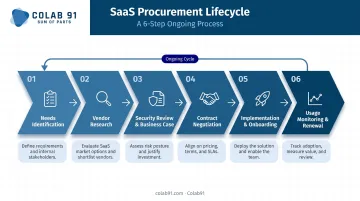
- The lifecycle runs from needs identification through ongoing contract and usage management - with no defined finish line.
- Common challenges include decentralized buying, hidden costs, and compliance gaps.
- SaaS management platforms and dedicated procurement expertise are what make this function scalable in practice.
What Is SaaS Procurement?
SaaS procurement is the strategic function through which organizations evaluate, acquire, and manage cloud-based software subscriptions. Unlike a one-time hardware purchase or a perpetual license, it's cyclical by design: subscriptions renew, usage shifts, pricing models change, and vendor relationships require active management throughout the contract lifecycle.
How It Differs from Traditional Software Purchasing
Traditional IT procurement had a clean finish line: buy the software, install it, done. SaaS procurement has no such endpoint. Subscriptions renew annually (sometimes monthly), pricing often scales with usage or seat count, and contracts require active management to avoid overpaying or getting locked in on unfavorable terms.
Each renewal is a decision point. Without structured oversight, costs drift, unused licenses accumulate, and contract terms quietly auto-renew on the vendor's preferred terms - not yours.
Who Owns It?
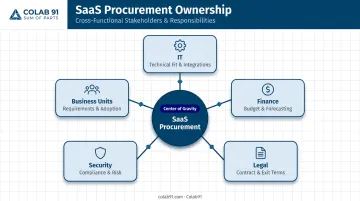
SaaS procurement spans multiple functions, each with a distinct role:
- IT - evaluates technical fit, security posture, and integration requirements
- Finance - manages budget allocation, spend tracking, and cost forecasting
- Legal - reviews contract terms, data ownership clauses, and exit provisions
- Security - assesses vendor compliance and data handling practices
- Business unit leaders - define functional requirements and drive adoption
No single team can manage this effectively in isolation. When ownership is unclear, things fall through the cracks - and with the average company now deploying 101 applications according to Okta's 2025 Businesses at Work report, the exposure from unmanaged subscriptions adds up fast. That's precisely why SaaS procurement needs a defined owner and a repeatable process behind it.
Key Benefits of Effective SaaS Procurement
Getting SaaS procurement right isn't just about avoiding waste - it creates real, measurable business advantages. Getting SaaS procurement right isn't just about avoiding waste - it creates real, measurable business advantages. The four areas below show where structured procurement consistently moves the needle.
Cost Optimization and Spend Control
Without visibility across the full SaaS portfolio, organizations consistently overpay. According to Productiv, 53% of SaaS licenses go unused - and Zylo's 2025 SaaS Management Index, based on data from over 40 million licenses, reports organizations waste an average of $21 million annually on unused SaaS licenses, up 14.2% year-over-year.
A structured procurement process gives finance and IT teams the visibility to eliminate duplicates, reclaim unused licenses, and align spend to actual usage.
Stronger Vendor Negotiation Leverage
Centralized procurement changes the negotiating dynamic fundamentally. When buying is fragmented across departments, each team negotiates in isolation - with no usage data, no market benchmarks, and no coordinated position. Centralized teams enter vendor discussions with:
- Real utilization data to challenge vendor seat counts
- Market benchmark pricing to counter list prices
- Well-documented business cases to justify concessions
- Contract history to identify unfavorable renewal terms
That preparation typically translates into lower unit prices, tighter SLA terms, renewal caps, and stronger exit clauses - outcomes that fragmented buying rarely achieves.
Better Security and Compliance Posture
Embedding security reviews into the procurement workflow - before a contract is signed - prevents high-risk tools from entering the stack. This is especially critical in regulated industries: healthcare organizations under HIPAA, financial services firms with SOC 2 obligations, and companies operating under GDPR all need vendor compliance verified before data touches a new system.
AppOmni's 2025 State of SaaS Security report found that 75% of organizations experienced a SaaS security incident in the past 12 months - a 33% increase from 2024. Procurement is one of the few control points where organizations can prevent these exposures before they happen.
Reduced Shadow IT and Governance Risk
When there's no formal procurement path, employees buy tools on personal credit cards or expense accounts. According to Zylo's data, lines of business now account for 70% of SaaS spend, while IT manages just 26.1%.
That gap creates predictable problems: security blind spots, inconsistent contract terms, and duplicate subscriptions no one is tracking. A structured procurement process won't eliminate shadow IT entirely, but it shrinks both the volume and the exposure - particularly for mid-market organizations where IT oversight is already stretched.
The SaaS Procurement Process: Step by Step
Step 1 - Needs Identification and Stakeholder Alignment
Before evaluating any vendor, document the business problem being solved. That means capturing:
- Functional requirements and success metrics
- Integration dependencies with existing systems
- User groups and budget constraints
- Whether an existing tool already covers the need
Aligning IT, finance, security, and the requesting business unit at this stage prevents delays and reduces rework later. Decisions made here shape every subsequent step.
Step 2 - Vendor Research and Evaluation
Define scoring criteria before reviewing vendors - not after. Evaluate against:
- Functional fit against documented requirements
- Security certifications and data handling practices
- Scalability and pricing model transparency
- Integration depth with existing systems
- Vendor financial stability and support quality
Request demos and pilot access to validate real-world performance. Tools with usage-based or AI-driven pricing models need especially careful evaluation - pricing unpredictability becomes a budget risk once the contract is signed.
Step 3 - Security Review and Business Case Development
Step 3 runs two parallel workstreams. Security teams assess the vendor against organizational standards - reviewing SOC 2 or ISO 27001 certifications, encryption practices, access controls, and incident response procedures. At the same time, the requesting team builds a business case with estimated ROI, productivity impact, and cost comparisons.
Both outputs land together: a security verdict and a financial rationale. The purchase decision should rest on both.
Step 4 - Contract Negotiation and Purchase Authorization
Price is only one dimension of a well-negotiated SaaS contract. Before signing, address:
- Usage rights - what's included at each tier, and what triggers overages
- Renewal terms - price caps that prevent surprise increases at renewal
- SLA commitments - uptime guarantees and remedies for failures
- Data ownership and portability - what happens to your data if you leave
- Exit clauses - how to terminate without penalties
Most organizations use tiered authorization based on spend thresholds and risk level, routing requests through finance, legal, and IT before finalization. The approval structure matters - it creates accountability and prevents impulsive purchases.
Step 5 - Implementation, Integration, and User Onboarding
After contract execution, IT and the requesting team configure the tool, set up integrations, establish user access controls, and deliver adoption training.
Poor onboarding is a real risk. If users don't understand how the tool improves their work, utilization stalls - and the investment fails regardless of how rigorous the procurement process was.
Step 6 - Usage Monitoring, Optimization, and Renewal Management
SaaS procurement doesn't end at go-live. Ongoing responsibilities include:
- Tracking license utilization by team and user
- Identifying underused or redundant applications
- Reviewing spend against budget quarterly
- Managing renewal dates proactively - with a minimum 90-day lead time before any contract end date
The data gathered through the contract period becomes the negotiating foundation at renewal. Organizations that review usage before renegotiating achieve better outcomes than those who accept the vendor's renewal quote without question.
Common Challenges in SaaS Procurement
Shadow IT and Decentralized Buying
With lines of business controlling 70% of SaaS spend, IT and procurement often lack visibility into a significant portion of the stack. This creates overlapping subscriptions, inconsistent contract terms, and security blind spots from tools that never went through a formal review.
SaaS Sprawl and License Underutilization
The average organization manages over 100 SaaS applications- a number that climbs as teams adopt tools independently, outside any central approval process. The cost of underutilization compounds: 53% of licenses go unused while organizations pay an average of $21 million annually for the privilege.
Hidden Costs and Pricing Complexity
Consumption-based and AI-driven pricing models introduce real budget unpredictability. According to Zylo's research, 78% of IT leaders experienced unexpected charges on a SaaS bill due to these pricing structures. Usage overages, misconfigured entitlements, and unplanned true-ups routinely push actual costs well above contract estimates.
Security and Compliance Gaps
Rushed or informal purchasing decisions frequently skip vendor security reviews. The risk scales with portfolio size - the larger and more fragmented the SaaS stack, the harder it becomes to maintain consistent compliance oversight.
Mid-market and PE-backed companies navigating M&A activity face this most acutely. Each acquisition adds an unfamiliar SaaS portfolio that may fall short of the acquiring organization's compliance standards - at exactly the moment internal teams have the least bandwidth to investigate. Common pressure points include:
- Inherited tools with unknown data-handling or access control configurations
- Duplicate vendors across merged entities with conflicting contract terms
- No centralized owner for newly acquired subscriptions
This is where dedicated offshore procurement support - such as the supplier risk management capabilities Colab91 provides through its offshore capability centers - can sustain oversight that stretched internal teams cannot.
Best Practices for Smarter SaaS Procurement
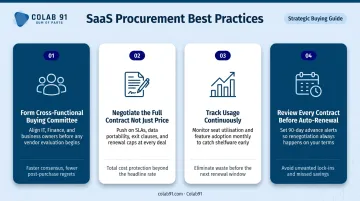
Strong SaaS procurement doesn't happen by accident. It requires deliberate structure - from how you form buying decisions to how you manage contracts over time. These four practices make the biggest difference:
Form a cross-functional buying committee first. Before evaluating any tool, document functional goals, integration requirements, user groups, and budget constraints. A committee spanning IT, finance, security, legal, and business stakeholders evaluates from multiple angles - and produces decisions that hold up well beyond the initial purchase.
Negotiate the full contract, not just the price. The most durable outcomes come from addressing data ownership rights, SLA commitments, renewal price caps, and exit flexibility before signing. Organizations that bring market benchmark data and current stack usage insights into vendor discussions consistently extract better terms.
Track usage continuously. Monitor license utilization, adoption rates, and per-team spend on an ongoing basis - not only when a renewal deadline forces a review. For mid-market firms and PE portfolio companies without dedicated SaaS procurement staff, this is where coverage gaps surface most visibly. Colab91 builds offshore procurement functions for clients specifically to ensure this monitoring happens consistently.
Review every contract before it auto-renews. Set calendar alerts at least 90 days before each renewal date. Review actual usage, benchmark current pricing against market rates, and decide whether to expand, consolidate, or replace the tool.
SaaS Procurement Platforms and Tools
What Is a SaaS Management Platform?
A SaaS Management Platform (SMP) is a centralized system of record for the entire SaaS portfolio. It gives procurement, IT, and finance teams unified visibility into:
- Application inventory, including shadow IT discovery
- Contract terms and renewal dates with alert calendars
- License utilization and user-level adoption data
- Spend forecasting and budget tracking
The core value is replacing fragmented spreadsheets and institutional memory with a single source of truth that the whole organization can act on.
What SMPs Deliver in Practice
A commissioned Forrester Consulting Total Economic Impact study found that Productiv's SMP delivered 234% ROI and $1.93 million in total benefits over three years for a composite 2,000-employee organization managing 240 SaaS applications. Application consolidation accounted for 67% of that benefit ($1.30 million), with contract negotiation and renewal visibility contributing an additional $360,000 in savings.
For organizations still tracking renewal dates manually - and 40% of organizations still do according to BetterCloud research - an SMP is a clear upgrade with measurable returns.
Choosing the Right Platform
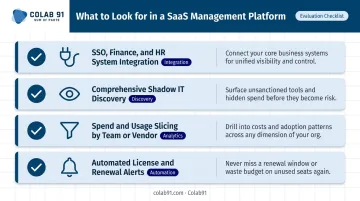
Leading SMP options include Torii, Zylo, Productiv, Zluri, Vendr, and BetterCloud. The ROI potential is real - but only if you pick a platform that fits how your organization actually works. When evaluating options, prioritize:
- Connects to your SSO, finance, and HR systems without heavy IT lift
- Identifies shadow IT comprehensively, not just sanctioned apps
- Lets you slice spend and usage data by team, vendor, or category
- Flags underutilized licenses and approaching renewals automatically
An SMP doesn't fix fragmented buying behavior on its own. The platform works best when paired with a defined procurement process and clear cross-functional ownership of the SaaS management function.
Frequently Asked Questions
What is SaaS in procurement?
In a procurement context, SaaS refers to cloud-delivered software subscriptions bought on a recurring basis. SaaS procurement is the structured process of evaluating, selecting, purchasing, and managing these subscriptions to control cost, reduce risk, and maximize value from the organization's software portfolio.
What are the key steps in the SaaS procurement process?
The core steps are:
- Needs identification and stakeholder alignment
- Vendor research and evaluation
- Security review and business case development
- Contract negotiation and purchase authorization
- Implementation and user onboarding
- Usage monitoring and renewal management
How is SaaS procurement different from traditional software procurement?
Unlike one-time purchases or perpetual licenses, SaaS procurement is ongoing - involving recurring renewals, usage-based pricing, and continuous vendor management. That lifecycle nature makes spend visibility and governance more critical than in a traditional buy-and-install model.
Who is responsible for SaaS procurement in an organization?
SaaS procurement is a shared responsibility across IT, procurement, finance, legal, and security teams. IT evaluates technical fit, finance owns the budget, legal reviews contracts, and security clears vendor risk - no single team controls the full process.
How do you manage SaaS vendor contracts effectively?
Centralize contract storage, track renewals with at least 90-day lead times, and negotiate exit terms and price caps upfront. Usage data gathered throughout the contract period is your strongest asset at renewal.
What tools support SaaS procurement?
SaaS Management Platforms (SMPs) are the primary tools - providing centralized visibility into the full application portfolio, contract tracking, usage analytics, and renewal management. Leading options include Torii, Zylo, Productiv, Zluri, Vendr, and BetterCloud.