Introduction
Most mid-market companies spend millions annually on third-party goods and services — yet a significant share of that spend remains invisible. Vendor names are inconsistent across systems, rebate entitlements go untracked, and category insights stay buried in spreadsheets until someone carves out time to investigate.
For PE-backed companies, this isn't a back-office problem. According to McKinsey, external supplier spend represents 40–80% of total company cost — making it one of the largest controllable cost levers available. In margin-pressured environments, that's a board-level conversation.
The problem is that manual processes — fragmented ERP data, inconsistent vendor naming, and siloed category reporting — can't keep pace with the scale of that exposure. AI-driven spend analysis closes that gap: classifying spend accurately, surfacing rebate entitlements automatically, and flagging savings opportunities before they expire. This post covers how that works in practice, and how to build a model that delivers results — not just dashboards.
Key Takeaways
- AI spend analysis classifies transactions faster and more accurately than manual methods, converting static reporting into continuous intelligence
- Rebate recovery is one of the most underutilized savings levers in mid-market procurement
- Clean, unified data is a prerequisite for AI insights, not a byproduct
- Pairing AI tools with domain expertise consistently delivers savings that neither achieves alone
- Mid-market and PE-backed firms can access enterprise-grade procurement analytics without building a full in-house team
What Is AI-Driven Procurement and Where Does Spend Analysis Fit?
AI-driven procurement applies machine learning, natural language processing, and predictive analytics to automate and optimize purchasing decisions — from supplier selection through invoice reconciliation. Rather than a single tool, it's a set of capabilities layered across the procurement lifecycle.
Spend analysis is the foundation layer. Without it, everything else — sourcing strategy, contract compliance, rebate tracking — operates on incomplete information.
What AI-Driven Spend Analysis Actually Does
AI spend analysis ingests raw data from ERP systems, AP feeds, purchasing cards, and invoice platforms, then:
- Normalizes inconsistent vendor names and line-item descriptions
- Auto-classifies transactions into standardized categories (UNSPSC or client-specific taxonomies)
- Builds a multi-dimensional spend cube — sliced by supplier, category, business unit, geography, and time period
- Surfaces savings opportunities, compliance gaps, and supplier concentration risks
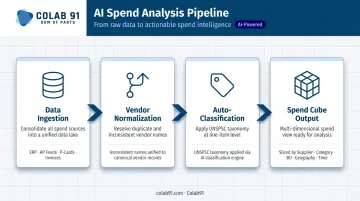
The result is granular spend visibility that procurement leaders previously couldn't achieve without weeks of manual work. One practical example: a company with 2,000 active vendors often discovers, after AI normalization, that 70–80% of spend sits with fewer than 50 suppliers.
Why This Matters Now
Deloitte's CPO survey found that 80% of CPOs ranked digital transformation as a top priority, with 70% experiencing increased procurement risk or supply disruption in the prior 12 months. High inflation was the primary driver. In that context, AI spend analysis functions as a margin protection tool, not an IT initiative.
For PE-backed portfolios specifically, KPMG notes that procurement optimization is a core EBITDA lever, not just a sourcing activity. That distinction matters: spend visibility improvements compound across the portfolio, making AI-driven analysis a repeatable value-creation mechanism rather than a one-time diagnostic.
How AI Turns Spend Insights into Measurable Cost Savings
Visibility alone doesn't save money. The savings come from acting on what the spend cube reveals. Here are the primary mechanisms.
Supplier Rationalization
AI identifies supplier fragmentation — multiple vendors performing the same function across business units — and quantifies the cost impact. McKinsey documents a case where one company consolidated from several hundred suppliers down to approximately 50, achieving 5–10% savings in the process.
The math is straightforward: fewer suppliers means higher spend concentration with each, which means stronger negotiating leverage and access to volume pricing tiers that weren't achievable when spend was fragmented.
Tail Spend Optimization
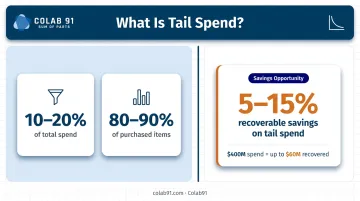
Tail spend — typically 10–20% of total spend but accounting for 80–90% of purchased items — is where AI has an outsized impact. Most organizations don't manage it at all because the transaction volume is too high and the individual values too low to justify manual attention.
AI brings structure to the long tail by:
- Flagging consolidation opportunities across fragmented suppliers
- Auto-routing purchases toward preferred vendors without manual intervention
- Identifying categories where spend is entirely unmanaged
McKinsey's research indicates companies can achieve 5–15% savings in tail spend through digital optimization. For a company with $400M in tail spend, that's up to $60M in recoverable value — money that was sitting in plain sight once the data was properly organized.
Contract Compliance and Leakage Recovery
AI cross-references actual purchase transactions against negotiated contract terms in real time. Price variances, missed discounts, and off-contract purchases surface automatically — not in a quarterly audit after the opportunity has already passed.
Colab91's procurement diagnostic work, which typically runs 4–6 weeks, routinely identifies 5–15% of addressable spend in recoverable savings across client engagements. Contract leakage and off-contract purchasing are consistent contributors to that range.
Category Benchmarking
AI-powered benchmarking compares a company's unit pricing, payment terms, and contract structures against market norms. This equips category managers with negotiating leverage grounded in data rather than intuition — walking into a renewal knowing a supplier is 15% above market is a fundamentally different position than relying on instinct alone.
AI-Powered Rebate Identification and Recovery
Rebates are one of the most systematically under-captured savings opportunities in mid-market procurement. Volume-based rebates, tiered annual spend commitments, and marketing development funds are all commonly negotiated — and commonly under-claimed.
The core problem is operational: tracking rebate entitlements against actual purchase volumes requires constant data reconciliation. Without automation, procurement teams rely on manual quarterly reviews — and by the time they identify a missed rebate tier, the quarter is over and the opportunity is gone.
How AI Changes the Equation
AI continuously reconciles actual purchase volumes against contract thresholds, creating visibility that manual processes simply can't match. This enables proactive decisions — consolidating orders with a preferred supplier in the final weeks of a quarter to ensure a rebate threshold is met, for example — rather than reactive ones.
The Safety Express case provides a clear example. After replacing spreadsheet-based tracking with Enable's platform, the company identified $204,000 in unaccrued rebate income, recovered $11,000 in intercompany rebates, and centralized tracking across 71 active rebate programs — all of which had previously required multiple days of manual quarterly reconciliation.
Early Payment Discounts
Rebate thresholds aren't the only lever. Early payment terms carry their own compounding value. A 2/10 Net 30 arrangement — a 2% discount for payment within 10 days — sounds modest. Annualized, it represents a 36.7% return on the working capital deployed. AI can model the financial trade-off between capturing that discount and the working capital impact, identifying which supplier invoices represent the strongest discount-to-cost ratio.
Connecting Rebates to Spend Strategy
AI's real leverage comes from linking rebate entitlements directly to the spend cube. Category managers can see, in a single view:
- Current spend concentration with each supplier
- Rebate thresholds and progress toward each tier
- Gap-to-threshold analysis by quarter
- Recommended purchasing actions to maximize realized rebates
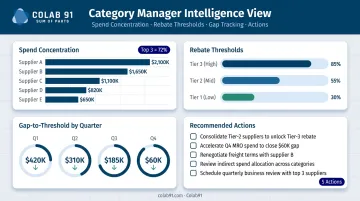
That integration means sourcing decisions carry a direct line to financial outcomes — category managers can see exactly which consolidation moves will trigger the next rebate tier before the quarter closes, not after.
Building the Right Operating Model for AI-Driven Procurement
Technology is the easier part. The harder part is building an operating model where AI outputs actually drive decisions.
The Human-Plus-AI Equation
AI surfaces insights. Domain expertise is what converts those insights into savings. Skilled procurement analysts and category managers must interpret AI outputs, validate findings, negotiate with suppliers, and drive adoption across business units. Without that expertise layer, spend dashboards go unused or produce insights that are misapplied.
The Hackett Group found that while 64% of organizations piloted RPA, only 9% reached large-scale deployment — and 50% of implementations failed to meet business objectives. The technology rarely fails. The operating model around it does.
The Offshore Capability Model as an Accelerant
Mid-market companies typically don't have the internal headcount to run continuous spend analysis alongside day-to-day procurement operations. Building an offshore analytics capability — staffed with experienced procurement practitioners who also understand AI tooling — is the most capital-efficient path to deploying these capabilities at scale.
Colab91's model addresses this directly. India-based procurement and analytics teams — staffed with domain practitioners, not generic data analysts — deliver continuous spend intelligence for US-based mid-market and PE-backed clients. The model produces:
- Weekly and monthly procurement intelligence packages (not annual point-in-time reports)
- Category strategy guidance informed by human analyst judgment on supplier dynamics
- AI-powered spend analytics layered on top of practitioner-led execution
- Ongoing savings tracking tied to sourcing decisions, not just dashboard views

The leadership team built and scaled a comparable model at Impendi (later acquired by Accenture), growing India-based procurement analytics operations to 100+ practitioners serving Carlyle Group, TPG, Elliott, and BC Partners. That PE-facing experience shapes how engagements are structured — and where teams focus first.
Data Governance: The Non-Negotiable Foundation
Deloitte identifies data quality as one of the biggest obstacles to AI success in procurement. Clean, unified, consistently coded spend data is a prerequisite for meaningful AI insights — not something AI automatically fixes.
Sustaining that quality over time requires:
- Consistent GL coding structures across business units
- Integrated data sources (ERP, AP, purchasing cards, contracts)
- Regular data refresh cycles managed by dedicated practitioners
- Governance structures that keep spend data current and trustworthy
The spend cube built on Day 1 is only as valuable as the data feeding it six months later.
How to Evaluate AI Vendors for Procurement
Not all procurement AI is equal. Gartner placed generative AI for procurement at the Peak of Inflated Expectations in 2024 — which means vendor claims need scrutiny before purchase.
Key Evaluation Dimensions
| Dimension | What to Assess |
|---|---|
| Data integration | Can it connect to your existing ERP and AP systems without heavy IT work? |
| Classification accuracy | What is the model's accuracy rate on uncategorized spend? Can they prove it? |
| Time-to-first-insight | How quickly does an initial spend cube appear after data ingestion? |
| Human support model | What expertise backs the tool, and how is ongoing support structured? |
| Data governance | How does the platform maintain data quality after initial deployment? |
Spotting AI-Washing
Many vendors claim AI capabilities that are, in practice, basic rule-based automation or keyword matching. To distinguish genuine ML-driven classification from marketing language:
- Ask for classification accuracy benchmarks on out-of-sample data
- Request an explanation of how the model handles vendor name normalization
- Run a pilot with a real sample of your messiest spend data before committing
- Ask how the model improves over time — static rule systems don't learn
Build vs. Buy vs. Partner
Mid-market companies generally have three paths forward:
- Buy a standalone spend analytics SaaS tool: fastest to deploy, but acting on the outputs requires internal procurement expertise you may not have
- Embed AI within an existing procurement platform: integration friction drops, though classification depth varies significantly by vendor
- Partner with a managed service provider: combines AI tooling with human expertise — the right fit for companies without dedicated procurement analytics teams
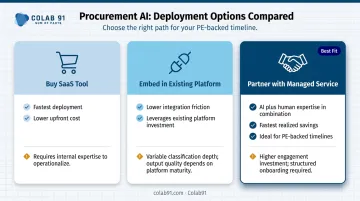
For PE-backed companies with tight value creation timelines, the partnership model delivers faster realized savings — insights reach practitioners who can act on them immediately, compressing the gap between analysis and impact.
Frequently Asked Questions
What is AI-driven procurement?
AI-driven procurement applies machine learning, NLP, and predictive analytics to automate and optimize the full procurement lifecycle — from spend classification and supplier selection through contract compliance and payment management. The result is faster decisions and lower costs across all purchasing activity.
What is AI-driven spend analytics and how does it benefit procurement?
AI spend analytics classifies raw transactional data into standardized categories automatically, giving procurement teams granular visibility into where money flows. This enables supplier consolidation, contract leakage recovery, and prioritized cost reduction — on a continuous basis, not just at year-end.
How do I evaluate AI vendors for procurement?
Assess vendors across data integration flexibility, classification accuracy benchmarks, time-to-first-insight, and the human support model behind the tool. Before committing, run a pilot using a real sample of your spend data — any vendor unable to demonstrate accuracy on your actual data is a risk not worth taking.
What types of rebates can AI help identify in procurement?
AI can track volume-based rebates triggered at purchase thresholds, early payment discounts, tiered pricing tied to annual spend commitments, and marketing development funds — all reconciled against live purchasing data in real time to ensure no entitlement goes unclaimed.
How much can AI-driven spend analysis typically save?
McKinsey's research puts savings from digital tail-spend optimization at 5–15% of tail spend, with supplier consolidation cases delivering 5–10% on rationalized categories. Colab91's procurement diagnostics typically identify 5–15% of addressable spend in recoverable savings opportunities. Actual results depend on data maturity, industry, and how aggressively insights are acted on.
What data does a company need to get started?
At minimum: 12–24 months of AP and invoice transaction data including vendor name, invoice amount, GL code, and business unit. Even messy, inconsistent data is a workable starting point — AI tools normalize and clean records during ingestion, not as a separate step afterward.