Introduction
Third-party procurement spend is one of the largest cost pools sitting inside any PE-backed business — and one of the least managed. According to Deloitte, most companies spend between 20% and 50% of total revenue procuring goods and services. For mid-market portfolio companies, that's a substantial number attached to fragmented supplier relationships, inconsistent contracts, and procurement teams too lean to run competitive sourcing.
PE firms inherit this mess at acquisition. Each portfolio company manages vendors in isolation, benchmarks nothing against market rates, and lets contracts auto-renew without renegotiation. The result: compounding margin pressure that compounds unnoticed across the entire hold period.
AI procurement changes that math — and firms generating the greatest EBITDA lift have figured out why. They fix root causes first: poor data, fragmented governance, and reactive buying behavior. Only then does tooling pay off.
This article maps where procurement costs originate across PE portfolios and how to eliminate them layer by layer.
Key Takeaways
- Procurement spend is 20%–50% of revenue for most companies — and rarely optimized at acquisition
- Hidden costs compound through siloed supplier contracts, untracked tail spend, and missed renewal windows
- AI accelerates savings identification, but requires clean data and governance to deliver real results
- Cross-portfolio leverage is the highest-value opportunity most PE firms have yet to capture
- Initial wins appear within 60–90 days; compounding savings build across the full hold period
How Procurement Costs Build Up Across PE Portfolios
Procurement costs in PE portfolios don't appear as a single visible line item. They accumulate across hundreds of vendor relationships, inconsistent contract terms, untracked tail spend, and non-competitive renewals — each portfolio company operating as if it were the only business in the fund.
The build-up is gradual and episodic. Costs spike at predictable moments:
- Contract renewal windows — when no one flags an auto-renewal until it's already rolled over at inflated rates
- Post-acquisition integration gaps — when procurement is deprioritized during the first 100 days in favor of operational firefighting
- Lean headcount periods — when procurement teams are too stretched to run competitive bids and default to incumbents
The overpayment stays hidden. Individual portfolio companies rarely benchmark their pricing against market rates or peer companies. Without a portfolio-wide spend analysis, no one sees the cumulative problem.
McKinsey's PE-specific research found that a two-to-three-week diagnostic for midsize portfolio companies can identify a procurement savings target equal to 10%–20% of EBITDA. That figure becomes more significant when you consider that it reflects costs already being paid — not projected efficiencies.
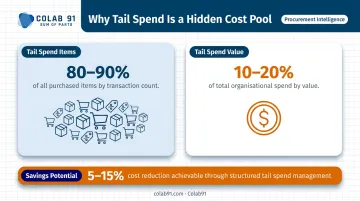
Tail spend compounds this further. McKinsey data shows it covers 80%–90% of purchased items while representing only 10%–20% of total spend. That's the fragmented, unmanaged zone where digital tools can deliver 5%–15% savings — but where stretched procurement teams rarely have the bandwidth to look.
Key Cost Drivers for PE Procurement
Absence of Portfolio-Wide Spend Visibility
Each portfolio company managing procurement independently means cross-company volume leverage is structurally impossible. Without aggregated data, there's no basis for price benchmarking, category standardization, or identifying which vendors serve multiple businesses at different rates.
For most PE-backed companies, this is simply the default state at acquisition — not an exception.
Fragmented Supplier Relationships
Without a consolidated negotiating position, portfolio companies often pay materially different prices from the same vendors. The result is predictable:
- No preferred vendor program or mechanism to enforce competitive pricing
- Multiple portfolio companies renewing contracts with the same supplier independently
- No visibility across businesses into what each is actually paying
Manual, Reactive Procurement Processes
When procurement teams spend the bulk of their time on transactional buying tasks, strategic activities don't happen. Renewal windows get missed. Competitive sourcing gets bypassed. Maverick spend — purchases outside negotiated contracts — accumulates steadily.
APQC benchmarks put the cost impact in concrete terms: organizations with 2%+ maverick purchasing require 16 more hours to issue a purchase order than those with less than 1%, and median procurement cost is $2.58 higher per $1,000 in purchases for high-maverick organizations. At $1B in annual purchases, that's over $2.5M in excess procurement costs from maverick spend alone.
Dirty, Fragmented Spend Data
This is the underlying driver that compounds all others. AI procurement tools cannot deliver accurate analysis or meaningful recommendations without clean, deduplicated, consistently categorized spend data.
Fragmented ERP systems, inconsistent vendor master files, and duplicate supplier records across portfolio companies are the primary reason AI procurement initiatives underdeliver. Data quality is a prerequisite cost issue, not an afterthought.
Cost-Reduction Strategies for AI Procurement
Strategies to reduce procurement costs across PE portfolios vary depending on whether the issue is rooted in how sourcing decisions are made, how procurement is managed day-to-day, or in the structural and data environment surrounding the function. All three levels require attention.
Strategies That Change Procurement Decisions
Apply AI-driven spend mapping during pre-deal due diligence. McKinsey's PE-specific research shows digital tools can lift EBITDA by 20% within six months for midsize portfolio companies — but that timeline compresses significantly when savings programs launch from day one rather than after a months-long diagnostic. Running spend analysis before deal close means the 100-day plan already has category targets, not just intentions.
Use AI-enabled category benchmarking to set negotiation targets. Machine learning models that compare a portfolio company's spend against market pricing data and peer benchmarks allow procurement teams to enter supplier negotiations with specific, defensible targets — not relationship intuition or historical rates. Gartner's 2023 survey of sourcing and procurement leaders found they expect GenAI to increase cost savings by 12% over the following 12–18 months, with productivity gains of 21%.
Consolidate supplier bases using cross-portfolio AI analytics. AI can identify instances where multiple portfolio companies purchase from the same vendors or in overlapping categories. That creates the opportunity to aggregate volume and negotiate preferred pricing at fund level rather than individually at each company — the single highest-leverage procurement action available to PE firms.
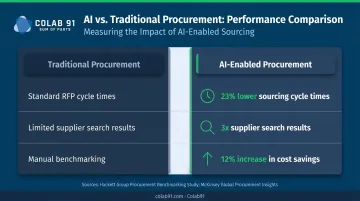
Replace manual RFPs with AI-automated competitive sourcing. Hackett Group data on Digital World Class procurement organizations shows 23% lower sourcing cycle times compared to peers. McKinsey notes that GenAI supplier searches produce 3x the results of traditional search engines, with RFP engines trained on more than 10,000 RFPs and responses. The effect is faster cycles and broader supplier competition.
Strategies That Change How Procurement Is Managed
Deploy real-time AI spend monitoring dashboards at the portfolio level. AI tools can flag unauthorized purchases, deviations from preferred vendor lists, and overspend against contracted rates as they occur — replacing the traditional model of discovering compliance issues through monthly or quarterly reporting cycles. Hackett Group data shows Digital World Class procurement organizations experience 59% less savings loss from maverick spend and contract noncompliance than peers.
Automate contract renewal tracking to prevent value leakage. World Commerce & Contracting research puts the average contract value leakage at 11% of contract value. AI contract lifecycle management tools alert procurement teams to upcoming renewals, identify auto-renewal risk, and surface renegotiation opportunities before contracts roll over at inflated rates. For PE portfolios running lean procurement teams, this prevents a category of loss that rarely surfaces in standard reporting.
Use AI for data-driven supplier performance management. Continuously scoring suppliers against KPIs — pricing competitiveness, delivery reliability, quality — gives procurement teams evidence-based grounds for deepening, renegotiating, or exiting supplier relationships. This shifts supplier management from reactive to proactive across the portfolio.
Enforce cross-portfolio compliance through AI benchmarking. GP-level reporting that compares spend behavior and unit pricing across portfolio companies creates accountability. Operating partners can identify underperforming procurement practices at individual companies and transfer best practices across the fund.
Strategies That Change the Structural Context Around Procurement
Invest in a unified, AI-ready procurement data layer before deploying AI tools. Fragmented ERP systems, inconsistent spend categorization, and duplicate vendor records are the primary reasons AI procurement initiatives fail to deliver projected savings.
Colab91's AI-powered spend analytics platform addresses this by cleansing, deduplicating, and classifying spend data against standardized taxonomies (UNSPSC or client-specific), then enriching it with supplier risk profiles, ESG ratings, and contract terms — building a durable data foundation, not a static snapshot.
Build an offshore procurement analytics capability center to sustain AI-powered intelligence. A dedicated India-based team provides the analytical depth of a large procurement function at a fraction of the cost — performing spend cube construction, category benchmarking, supplier performance scoring, and savings tracking on a continuous basis.
Colab91 has built this model for PE sponsors including Carlyle Group and TPG, scaling multifunctional analytics teams that serve as global intelligence hubs across the portfolio. Everest Group's 2026 analysis confirms that India-based procurement teams are actively shifting from downstream execution toward strategic roles — making this model increasingly viable for high-complexity work.
Shift procurement governance from portco-level to fund-level for high-spend categories. Structural fragmentation is often the real cost driver — not the procurement processes themselves. PE operating partners who centralize category ownership, vendor relationships, and contract templates for major spend categories at the fund level eliminate redundancy and unlock leverage that individual portfolio companies cannot access alone. IT/SaaS, telecom, professional services, and marketing services are the categories where this shift delivers the most immediate impact.

Use supplier AI adoption as a cost recapture opportunity. As suppliers use AI to reduce their own operational costs, McKinsey projects agentic AI could increase procurement efficiency by 25%–40% by shifting hours from transactional work. PE-backed procurement teams can use market data and spend analytics to quantify supplier cost reductions and incorporate them into renegotiations— converting a market-wide efficiency gain into a negotiable concession.
Conclusion
Reducing procurement costs across a PE portfolio starts with an accurate diagnosis of where costs actually originate — whether in poor sourcing decisions, weak management visibility, or structural data and organizational gaps. Deploying AI tools without addressing these root causes will underdeliver, regardless of how sophisticated the tools are.
The firms generating the greatest EBITDA impact treat procurement AI not as a one-time initiative but as embedded infrastructure. They build the data foundations early, establish fund-level governance, and run analytical programs continuously across the hold period. Done right, procurement savings don't just reduce costs — they accumulate into exit multiples that are measurably higher.
Frequently Asked Questions
Will procurement survive AI?
Procurement won't disappear but will fundamentally change. AI automates transactional and analytical tasks, freeing procurement professionals to focus on strategic sourcing, supplier relationships, and cross-portfolio value creation. The role evolves from tactical buyer to intelligence-driven strategist.
How does AI procurement improve EBITDA for PE portfolio companies?
AI procurement improves EBITDA by reducing third-party spend through data-driven sourcing and renegotiation, eliminating savings leakage through automated contract compliance, and enabling lean procurement teams to manage larger spend volumes without proportional headcount increases.
What types of procurement costs are most reducible through AI for PE firms?
Indirect spend categories — including marketing, IT, professional services, and facilities management — are most reducible. Market benchmarking data is available, competitive alternatives are abundant, and AI can most easily surface overpayment relative to fair market rates in these categories.
How do PE firms scale AI procurement across multiple portfolio companies?
Scaling requires a combination of portfolio-level data infrastructure, fund-level category governance, and a shared analytical capability — either an internal operating team or an offshore capability center — that applies consistent AI-powered intelligence across all portfolio companies.
What data infrastructure is required before AI procurement can deliver ROI?
AI procurement tools require clean, consistently categorized spend data across suppliers, cost centers, and business units. Firms should prioritize deduplicating vendor master data, standardizing spend taxonomy, and integrating ERP data before expecting AI models to produce reliable savings recommendations.
How quickly can PE-backed companies see savings from AI-enabled procurement?
Quick wins from supplier consolidation, contract renegotiation, and spend compliance enforcement can surface within the first 60–90 days. McKinsey research on PE procurement diagnostics shows that fast-starting companies capture at least 16% of financial targets within the first three months. Savings compound as AI monitoring and cross-portfolio leverage scale through the hold period.