The gap between what strategic sourcing promises and what it actually delivers isn't a planning failure. It's an execution failure. And for mid-market and PE-backed companies operating with lean teams, fragmented data, and limited analytics infrastructure, that gap is wider than most CPOs want to admit.
This article covers five core challenges that consistently derail strategic sourcing programs—and the structural fixes that address each one.
Key Takeaways
- Strategic sourcing fails most often in execution, not in planning—governance and discipline matter as much as analytical rigor
- Poor spend visibility, supplier risk, maverick spend, talent gaps, and savings leakage are the five most persistent challenges procurement leaders face
- Each challenge has a structural fix; teams that address all five systematically outperform those that treat sourcing as a periodic event
- Mid-market and PE-backed companies can access specialized sourcing analytics talent through offshore teams—without adding onshore headcount
Why Strategic Sourcing Falls Short in Execution
Strategic sourcing is designed as a continuous discipline—spanning spend analysis, supplier evaluation, contract governance, and performance monitoring. In practice, most organizations treat it as an episodic activity that ends at contract signature — and the execution gap opens the moment the ink dries.
The breakdown points are predictable:
- Between supplier selection and contract governance
- Between contract award and purchasing compliance
- Between negotiated savings and validated financial impact
Ardent Partners research found that the average organization loses 21% of cost savings annually to savings leakage, with typical sourcing contracts leaking between 14% and 26%.
For mid-market and PE-backed companies, this gap is amplified by resource constraints:
- Small procurement teams managing broad category portfolios
- Limited analytics infrastructure for continuous spend monitoring
- No formal category management cadence to sustain sourcing outcomes
The five challenges below explain where and why execution breaks down — and what it takes to close the gap.
Fragmented Spend Data and Lack of Visibility
The Challenge
Sourcing decisions are only as good as the data behind them. When spend data is fragmented across ERPs, procurement systems, and decentralized purchasing channels, category teams lose the visibility they need to prioritize sourcing waves, benchmark suppliers, and validate savings.
The downstream effects are concrete: missed consolidation opportunities, reactive category strategy, and weakened negotiating leverage going into the market.
ISM's 2023 Data and Analytics Survey found that 47% of organizations had no Master Data Management strategy, and more than 25% of respondents spent 20% or more of their day just locating data. For mid-market and PE-backed companies following M&A activity—where multiple ERP environments are stitched together and taxonomy is inconsistent across entities—this problem is acute.
The Solution
The foundational fix: standardize supplier and category taxonomy across the organization, and centralize procurement intake into a single channel. Without this baseline, no analytics investment will deliver consistent results.
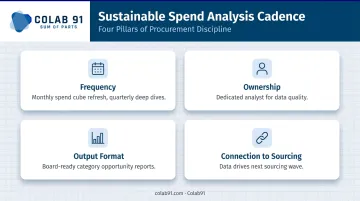
Beyond the foundation, spend analysis needs to function as a recurring discipline, not a one-time exercise. A sustainable cadence looks like:
- Frequency: Monthly refresh of spend cube; quarterly category-level deep dives
- Ownership: Dedicated analyst accountable for data quality and output delivery
- Output format: Board-ready reports with category-level opportunity flags
- Connection to sourcing: Spend data directly informs the next sourcing wave sequence
Ardent Partners data shows that enterprises using automated spend analysis are 87% likely to use data to identify sourcing and consolidation opportunities, versus only 47% of organizations without those tools. The gap between those two numbers comes down to one thing: analyst capacity.
Most mid-market teams don't have the dedicated resources to sustain rigorous, continuous spend analytics. Colab91's India-based procurement analytics teams address this directly—delivering spend cube construction, off-contract spend identification, and vendor consolidation analysis on weekly and monthly cadences, without adding to onshore headcount.
Supplier Risk, Reliability, and Compliance Gaps
The Challenge
As sourcing becomes more global, risk exposure across regulatory, financial, geopolitical, and operational dimensions increases. The problem is that cost optimization tends to dominate supplier evaluation criteria—and risk gets underweighted until something goes wrong.
Deloitte's 2023 Global CPO Survey reported that 43% of CPOs said overall procurement risk had increased significantly, up from 20% in 2021. Yet only 25% of firms could identify and predict supply disruptions in a timely manner, and only 15% had visibility into tier 2 suppliers and beyond.
The risk vectors procurement teams most commonly underestimate:
- Single-source dependency in critical categories
- Supplier financial instability
- ESG compliance gaps
- Geopolitical concentration (over-reliance on single-country supply bases)
- Logistics and operational disruption
The Solution
Risk assessment belongs inside the sourcing process—not in a separate compliance function that reviews supplier awards after the fact. In practice, this means:
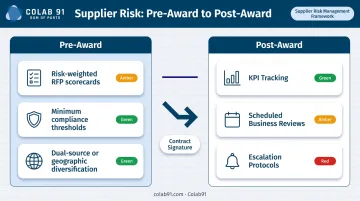
- Embedding risk-weighted criteria into RFP scorecards: tiered weighting across financial health, operational reliability, ESG compliance, and geopolitical exposure
- Setting minimum compliance thresholds: suppliers below acceptable risk scores are disqualified before commercial evaluation begins
- Dual-source or geographic diversification for critical categories where single-source dependency creates unacceptable exposure
Getting the award decision right is only half the job. Post-award, supplier oversight needs to remain active: KPI tracking, scheduled business reviews, and defined escalation protocols should be standard practice, not exception handling. Risk exposure continues after contract signature — it simply gets harder to see without structured monitoring in place.
Colab91's AI-powered Supplier Risk Management platform is built for exactly this post-award gap, providing continuous monitoring across financial health, ESG compliance, sanctions screening, and operational risk, with automated alerts when risk scores shift materially.
Maverick Spend and Weak Procurement Governance
The Challenge
Maverick spend—purchasing that bypasses approved procurement channels—is one of the most persistent sourcing challenges precisely because it's structural, not accidental.
The typical bypass scenarios:
- Business users engaging suppliers directly for urgency or convenience
- Contract renewals processed without competitive review
- Purchase requests that circumvent procurement thresholds
Each scenario erodes negotiating leverage before a sourcing event can even start. When procurement is brought in after informal supplier selection has already happened, the formal sourcing process becomes a compliance exercise rather than a value-creation one.
The Hackett Group's research found that Digital World Class procurement organizations have 59% less savings loss from maverick spend and contract noncompliance than peers—a gap that reflects governance maturity, not just technology investment.
The Solution
Closing those bypass gaps requires two components working together—one to control when procurement gets involved, and one to ensure sourced savings actually stick.
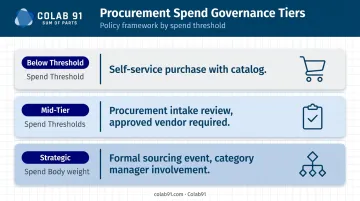
First, sourcing thresholds that trigger formal procurement involvement. Effective governance looks different at different spend tiers:
| Spend Tier | Governance Requirement |
|---|---|
| Below threshold | Self-service purchase with catalog |
| Mid-tier | Procurement intake review, approved vendor required |
| Strategic | Formal sourcing event, category manager involvement |
Second, connecting sourcing outcomes to purchasing controls. Governance isn't about friction—it's about ensuring that negotiated savings are actually captured during purchasing. That means:
- Linking sourced awards to approved vendor lists and digital catalogs
- Enforcing contract-backed pricing at the PO level
- Routing off-catalog requests through a structured approval workflow
Colab91's Procurement Strategy & Transformation engagements cover source-to-pay process redesign and governance framework development. That includes building the threshold structures and intake workflows that make procurement involvement automatic—so compliance becomes the default, not the detour.
Talent Shortages and Limited Analytical Capacity
Strategic sourcing is a capability-intensive function. Effective sourcing requires proficiency across spend analytics, market intelligence, supplier financial analysis, TCO modeling, and negotiation strategy. For mid-market and PE-backed companies with lean procurement teams, this breadth of expertise is rarely available in-house.
The result is reactive, price-focused sourcing rather than the value-optimizing approach the function is designed to deliver.
Deloitte's 2025 CPO Survey identified the core execution barriers: 57% cited siloed ways of working, 46% said competing priorities diluted focus, and 40% pointed to organizational or technology capability gaps. The talent shortage sits underneath all three.
The trade-offs organizations face are real:
- Hiring senior onshore talent is expensive, slow, and typically yields a generalist rather than a category specialist
- Generalist staff lack the analytical depth that rigorous sourcing actually requires
- Episodic consultant engagements provide transactional help but leave no lasting capability behind
This talent gap is a root cause—not a symptom—of many of the other challenges in this article. Poor data quality, weak governance, and savings leakage all trace back to insufficient analytical capacity to sustain the sourcing discipline post-award.
Specialized offshore capability centers address this directly. Colab91 builds dedicated India-based teams with deep domain expertise in strategic sourcing and spend analytics, giving procurement leaders the analytical capacity to run rigorous sourcing processes, maintain continuous spend visibility, and support category strategy — all without expanding onshore fixed costs.
For PE portfolio companies where speed-to-value matters and cost structures are scrutinized, this model is particularly effective. Colab91's Savings Opportunity Assessment compresses the diagnostic phase to 4-6 weeks, typically identifying 5-15% of addressable spend as recoverable savings before a broader engagement begins.
Savings Leakage After Contract Award
Savings leakage is the clearest signal that a sourcing function isn't operating as an integrated discipline. The mechanics are straightforward: negotiated value disappears between contract signature and purchasing execution.
Common leakage points:
- Off-contract buying by business units unaware of awarded terms
- POs that bypass negotiated pricing due to catalog misalignment
- Manual compliance checks that are set up but rarely enforced
- Contract renewals that revert to prior pricing rather than locked terms
Ardent Partners research found that connecting sourcing and contracts can reduce leakage by nearly 40-50%—a meaningful return on what is a governance investment, not a technology one.
Closing the leakage gap requires integrating the full lifecycle:
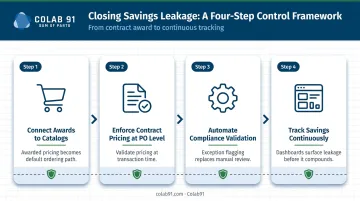
- Connect sourcing awards to digital catalogs so awarded pricing becomes the default ordering path, not an optional one
- Enforce contract-backed ordering at the PO level, validating pricing at transaction time rather than during month-end reconciliation
- Automate compliance validation so exception flagging replaces manual review
- Track negotiated versus realized savings continuously through dashboards that surface leakage before it compounds
When sourcing, contracting, and purchasing operate as separate silos, value erosion is structural. Closing the gap requires governance reform across all three functions — stronger front-end negotiation alone won't hold the savings.
Frequently Asked Questions
What are the four pillars of strategic sourcing?
The four commonly cited pillars are spend analysis, supplier evaluation and selection, negotiation and contracting, and supplier performance management. Each pillar feeds the next, creating a continuous cycle where performance data from one contract cycle informs the next sourcing decision.
Why do strategic sourcing initiatives fail to deliver expected savings?
The most common root cause is the execution gap: the disconnect between negotiated outcomes and purchasing compliance. Weak governance, siloed systems, and limited analytical resources all compound this gap, allowing value to erode between contract award and actual purchasing behavior.
What is maverick spend and how does it affect strategic sourcing?
Maverick spend is purchasing that bypasses approved procurement channels, including direct supplier engagement, off-catalog buying, or contract renewals without competitive review. It undermines negotiated pricing, weakens supplier consolidation efforts, and makes compliance tracking unreliable across the sourcing portfolio.
How can mid-market companies build strategic sourcing capabilities with limited resources?
Practical options include structured offshore analytics teams, phased capability building focused on the highest-impact categories first, and domain-expert partners who augment in-house capacity without adding significant fixed cost. The goal is analytical depth on demand, not permanent headcount.
What is the difference between strategic sourcing and procurement?
Procurement covers the full acquisition function: purchasing, vendor management, contracting, and P2P operations. Strategic sourcing is the analytical subset within it, focused on supplier selection, contract structuring, and value optimization for high-impact spend categories.
How does supplier risk management fit into a strategic sourcing strategy?
Supplier risk management should be embedded into the evaluation and selection process, not treated as a separate compliance function. Risk criteria belong in weighted RFP scoring, and monitoring should continue post-award across financial, operational, ESG, and geopolitical dimensions.