Introduction
Mid-market and PE-backed retailers are caught in a familiar bind: input costs rising, supply chains unpredictable, savings targets mounting — and procurement teams that haven't grown to match any of it.
The Hackett Group found that procurement workload was expected to rise 8.0% in 2024, creating a 6.6% productivity gap with little increase in headcount or budget. For retailers managing seasonal demand swings, fragmented supplier bases, and thin margins, that gap doesn't just slow things down — it directly erodes profitability.
Retail procurement managed services has emerged as a practical answer: a standing delivery capability that runs sourcing events, manages suppliers, captures tail spend, and produces procurement intelligence against defined service levels. It's not a project engagement or a temporary staffing fix — it's an ongoing operational function built to close the gap.
This guide covers what retail procurement managed services is, the key challenges it solves, five best practices for structuring it effectively, how to choose the right operating model, and the KPIs that tell you it's working.
Key Takeaways
- Retail procurement managed services is an ongoing delivery capability covering sourcing, supplier management, contract support, and tail spend — not a one-time project.
- Measuring activity instead of outcomes is the most common failure mode — define throughput targets before day one.
- Scope ambiguity between the managed team and internal stakeholders drives most underperformance.
- A hybrid onshore/offshore model gives most mid-market retailers the best combination of strategic depth and cost efficiency.
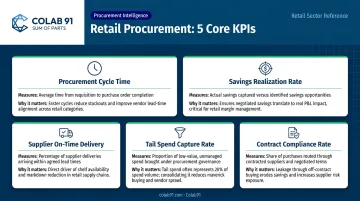
- Five KPIs matter most: procurement cycle time, savings realization rate, supplier on-time delivery, tail spend capture rate, and contract compliance rate.
What Is Retail Procurement Managed Services?
Retail procurement managed services is the outsourcing of specific, repeatable procurement functions — strategic sourcing, supplier onboarding, tail spend management, contract administration — to an external team that operates within the retailer's existing environment, platforms, and processes.
The managed team doesn't replace your P2P system or rebuild your category strategy from scratch. It plugs into what you have and runs defined functions continuously, against agreed service levels — operating within your environment, not around it.
This distinguishes it from two commonly confused alternatives:
- Staff augmentation fills seats. Someone shows up, takes direction, and leaves. There's no accountability for outcomes.
- Traditional consulting delivers recommendations. You get a roadmap; execution is your problem.
Managed services delivers ongoing throughput. Sourcing events completed. Suppliers onboarded, contracts renewed, tail spend routed. Every month, against targets.
That consistency matters most in retail, where the structural complexity of the environment creates more failure points than most procurement teams are staffed to handle.
What Makes Retail Specifically Complex
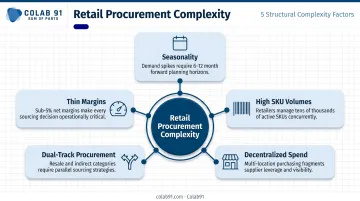
Retail procurement isn't generic procurement with a different logo. It has structural characteristics that make it harder to manage and easier to get wrong:
- Seasonality creates compressed sourcing windows where delays translate directly into stockouts or margin loss
- High SKU volumes — the average supermarket carried 31,795 items in 2024, each with its own supplier and replenishment cycle
- Decentralized spend — nearly 50% of retail indirect spend is managed at the store level, far from central procurement oversight
- Dual-track procurement — direct and indirect categories running simultaneously, with very different supplier dynamics
- Thin margins where a sourcing error or compliance lapse has immediate P&L consequences
Retailers also employ only one-eighth the number of dedicated indirect sourcing personnel compared to the cross-industry average. Managed services exists specifically to close that gap.
Key Challenges That Managed Services Solves for Retailers
Capacity Bottlenecks
The workload-versus-headcount gap is the most common trigger. When procurement volume grows faster than team capacity, the backlog doesn't just slow delivery — it forces the team into reactive mode, abandoning strategic work to keep tactical operations moving.
Managed services converts a fixed-capacity constraint into a scalable delivery model. Volume spikes during a seasonal peak or new category initiative? The delivery layer absorbs it. When volume normalizes, the model adjusts — internal headcount stays stable while throughput flexes.
Tail Spend and Maverick Buying
Decentralized retail operations — across stores, regions, or channels — generate high volumes of low-value, off-contract purchases. Store managers buy locally. Regional teams negotiate their own agreements. No one routes spend through approved suppliers consistently.
The cost is significant. Hackett Group found that Digital World Class procurement organizations experience 59% less savings loss due to maverick spend and contract noncompliance than their peers. That gap closes when a managed services provider installs a consistent intake-to-procure workflow that captures purchases and routes them through approved channels — before the spend happens, not after it's reported.
Supplier Relationship Gaps
Most retail supplier relationships are purely transactional. Orders go in, goods come out, and no one tracks whether suppliers are actually performing against agreed terms. Scorecards don't get built. Issues escalate slowly because there's no formal protocol to catch them early.
Managed services providers bring structured supplier management frameworks that most mid-market retailers lack the bandwidth to operate internally:
- Performance reviews conducted on a defined cadence against agreed KPIs
- Escalation triggers set proactively, so issues surface before they become disruptions
- Systematic data collection on delivery, quality, and compliance — not ad hoc reporting
The gap isn't awareness — it's capacity. Internal teams know what good supplier management looks like; they just can't execute it while managing day-to-day operations.
Best Practices for Retail Procurement Managed Services
Best Practice 1 — Anchor the Engagement to Outcomes, Not Activities
Every managed services arrangement should start with a short list of measurable outcomes:
- Sourcing events completed per month
- Contract cycle time (intake to award)
- Tail spend captured as a percentage of total spend
- Savings realized against pipeline target
Without this, managed services drifts. The team stays busy, reports are produced, meetings happen — but no one can answer whether the engagement is delivering value. Activity metrics create the appearance of accountability without the substance of it.
Define outcome targets before go-live. Attach them to the contract. Review them monthly.
Best Practice 2 — Define Scope and Swim Lanes with Surgical Precision
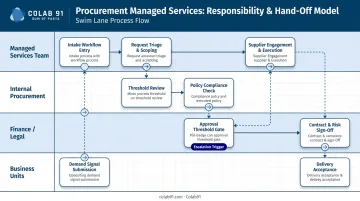
Scope ambiguity is the single most common cause of managed services underperformance. When it's unclear who owns the intake process, who approves sourcing events, who escalates to legal, and who communicates results to business units — the engagement stalls at every hand-off point.
Before go-live, document:
- Intake workflows: how procurement requests enter the managed services queue
- Approval paths: who authorizes what, at what spend threshold
- Escalation triggers: which situations require internal escalation versus managed team resolution
- Hand-off points: exactly where the managed team's responsibility ends and the internal team's begins
A RACI matrix covering the managed team, internal procurement, finance, legal, and business units isn't bureaucracy. It's the operating agreement that prevents six months of friction.
Best Practice 3 — Build Supplier Intelligence as a Shared, Compounding Asset
Managed services should produce durable procurement knowledge — not just transactional outputs. Every sourcing event, every supplier interaction, every contract renewal is an opportunity to build intelligence that improves the next one.
This means building and maintaining:
- Supplier scorecards: track delivery, quality, and compliance over time
- Category spend analyses: reveal consolidation opportunities and pricing benchmarks
- Contract playbooks: encode negotiation history and preferred terms
The productivity difference is material. APQC found that organizations with structured spend analysis programs spend a median of 0.17% of revenue on procurement activities, versus 0.39% for those without — and require 72 procurement FTEs per $1 billion in purchases versus 159.4 FTEs without spend analysis.
Colab91's AI-powered Spend Analytics platform is built around this principle: it cleanses, classifies, and enriches spend data into a unified layer that grows more accurate over time. For retail clients, that translates directly to category benchmarks, vendor consolidation opportunities, and off-contract spend identification that improve with each engagement quarter.
Best Practice 4 — Integrate Demand Signals into the Managed Sourcing Cycle
Retail procurement doesn't exist in a planning vacuum. Seasonal calendars, promotional timelines, and sell-through data all drive sourcing needs. If the managed team is waiting for a purchase request to trigger a sourcing event, they're already behind.
High-performing retail managed services engagements connect sourcing workflows to demand planning inputs:
- Holiday and seasonal procurement triggered 12–16 weeks in advance of need dates
- Promotional sourcing events aligned to marketing calendars
- Reorder sourcing triggered by inventory thresholds, not stockout alerts
This requires the managed team to have visibility into demand signals — and a formal process for acting on them proactively. The alternative is reactive sourcing under time pressure, which produces worse supplier terms and more single-source awards.
Best Practice 5 — Establish Formal Governance Cadences and a Continuous Improvement Loop
The operating rhythm separating high-performing managed services from those that stagnate:
| Cadence | Focus |
|---|---|
| Weekly | Prioritization review — what's in the queue, what's blocked, what's escalating |
| Monthly | Value review — KPI performance, savings realization vs. target, pipeline health |
| Quarterly | Contract/scope assessment — are service levels still aligned to business priorities? |
Governance isn't overhead. It's how the engagement adapts. Business priorities shift. New categories emerge. Supplier landscapes change. Without a formal mechanism to surface these shifts and adjust scope accordingly, the managed services engagement optimizes for last quarter's priorities — not this quarter's.
The managed services provider should own the reporting for these reviews, not the internal team.
Building the Right Managed Services Operating Model for Retail
Onshore, Offshore, or Hybrid
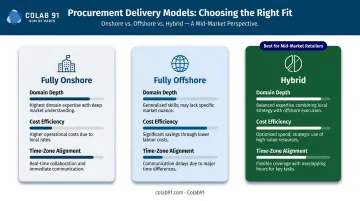
Three delivery models exist, each with real tradeoffs:
| Model | Cost Efficiency | Domain Depth | Speed of Deploy | Time-Zone Fit |
|---|---|---|---|---|
| Fully Onshore | Lower | High | Slower | Aligned |
| Fully Offshore | Higher | Variable | Faster | Misaligned |
| Hybrid | Best | High | Balanced | Manageable |
For most mid-market and PE-backed retailers, the hybrid model is the right answer. An onshore layer handles stakeholder-facing relationship management, category strategy, and escalation. An offshore delivery layer runs the high-volume, repeatable work — RFx execution, spend analytics, supplier data management, contract administration — at materially lower cost.
Deloitte's 2025 Global Business Services Survey found that 55% of organizations with a global GBS delivery model achieved over 20% average savings. And Kearney's 2023 Global Services Location Index ranked India first among 60 countries for offshore services delivery — citing cost advantage, talent pool depth, and skills availability.
Mid-market retailers consistently under-leverage offshore capability. The assumption that offshore delivery means lower quality is outdated. With the right domain expertise in the offshore layer, quality improves — because dedicated specialists work categories full-time rather than as a fraction of an overloaded generalist's role.
Colab91's Capability Center Model
Colab91's model is purpose-built for this hybrid structure. The onshore layer — led by Directors with backgrounds from Impendi (acquired by Accenture) — provides US-based stakeholder management, strategic procurement guidance, and retail category expertise.
The offshore delivery layer, based in Gurugram, covers the full execution stack across retail-specific spend categories:
- NFR indirect spend — store operations, fixtures, maintenance, signage, store technology
- Retail marketing — agency spend, promotional materials, in-store media
- Supply chain — 3PL, freight, last-mile logistics
- Retail technology — POS, OMS, WMS, payments
Retailers access domain-experienced analysts and category managers without building a delivery center from scratch — and without the overhead of a full onshore team for every function.
Key Design Decisions Before Deployment
Before any managed services operating model goes live, four decisions need resolution:
- Technology integration: Which P2P or S2P platform (Coupa, Ariba, Jaggaer, GEP) the managed team will operate within, and what access levels are required
- Data access and security: Protocols for spend data sharing, supplier data handling, and system permissions
- Team structure: Dedicated versus shared resources — and what that means for response time and category depth
- Knowledge transfer: How supplier intelligence, category data, and contract history remain the client's asset if the engagement ends
The last point is critical. Vendor lock-in in managed services happens when the provider owns the knowledge. Build knowledge transfer into the contract from day one.
PE Portfolio Retail Companies
PE-backed retail portfolio companies have a structural advantage most don't fully use: the ability to deploy a standardized managed services model across multiple portfolio entities at once. Cross-portfolio leverage means a PE sponsor's retailers negotiate 3PL contracts, store fixture agreements, and POS vendor terms collectively — not separately.
The financial case is clear. McKinsey found that a successful procurement transformation in PE can increase run-rate EBITDA by up to 20%, with a total procurement target of 10% to 20% of EBITDA achievable after a 2–3 week diagnostic.
Colab91 supports PE sponsors with:
- Portfolio-wide procurement diagnostics across all entities within 6–8 weeks
- Cross-portfolio category leverage programs for high-spend categories
- Shared GCC infrastructure for procurement and analytics functions
A company-by-company approach won't compress timelines the way a coordinated portfolio model can.
Measuring Success: KPIs for Retail Procurement Managed Services
The Five Core Metrics
| KPI | What It Measures | Why It Matters in Retail |
|---|---|---|
| Procurement cycle time | Days from intake to award | APQC benchmarks median sourcing cycle at 60 days; retail seasonality makes speed critical |
| Savings realization rate | Actual savings captured vs. pipeline target | Identifies whether identified opportunities convert to real P&L impact |
| Supplier on-time delivery | Percentage of deliveries meeting agreed dates | Proxy for relationship management quality and contract terms enforcement |
| Tail spend capture rate | Unmanaged spend brought into compliant channels | Tracks whether maverick buying is actually declining over time |
| Contract compliance rate | Purchases through preferred suppliers and approved channels | Measures whether negotiated savings are being captured at point of purchase |
How to Use These KPIs
Review KPIs monthly in formal value reviews. Adjust targets quarterly to reflect changing business priorities. The managed services provider should own reporting — not the internal team. If the internal team is building the performance deck, the engagement has already drifted toward staff augmentation.
Tracking the right mix of indicator types is where most retail teams fall short. Both categories need simultaneous visibility:
- Lagging indicators (realized savings, compliance rate) confirm that value was captured
- Leading indicators (sourcing pipeline volume, cycle time trends, active RFx count) signal whether the engagement is on track to hit targets in the next quarter
- Risk signals (supplier concentration shifts, category price volatility, contract expiration clustering) flag exposure before it becomes a P&L event
Retail procurement leaders managing annual savings targets can't wait for lagging indicators to confirm they've missed a quarter. When leading indicators show pipeline volume dropping in Q2, there's still time to reopen sourcing events before the holiday season locks in supplier terms.
Frequently Asked Questions
What is retail procurement?
Retail procurement is the end-to-end process of sourcing, purchasing, and managing the goods, services, and technology retailers need to keep operations running and shelves stocked. It covers supplier selection, contract negotiation, inventory coordination, and spend control — across both direct (goods for sale) and indirect (operational) categories.
What's the difference between procure-to-pay (P2P) and source-to-pay (S2P)?
P2P covers the transactional steps from purchase requisition through invoice payment. S2P is broader, adding upstream sourcing activities — supplier identification, RFx events, and contract negotiation. S2P is the more comprehensive framework for managed services engagements, covering the full value creation cycle.
What are the 4 types of procurement?
The four types are: direct procurement (goods for resale or production), indirect procurement (operational goods and services), services procurement (external providers like logistics, legal, and IT), and managed procurement (outsourcing procurement functions to a specialist provider). Retail organizations typically operate across all four simultaneously — making category prioritization and governance essential.
What are the 5 pillars of supply chain management?
Plan, source, make, deliver, and return. Retail procurement managed services primarily operates within the "source" pillar — but the supplier intelligence and spend data it generates directly improve performance across planning, delivery, and returns management as well.
When should a retailer consider procurement managed services?
Three clear trigger conditions: a persistent sourcing backlog that doesn't clear despite team effort, an inability to execute the savings pipeline fast enough to hit annual targets, and internal procurement capacity consumed entirely by tactical activity at the expense of strategic work.
What KPIs should retail procurement managed services track?
Procurement cycle time, savings realization rate, tail spend capture rate, supplier on-time delivery, and contract compliance rate. A well-structured engagement should own reporting on all five — on a monthly basis — so internal leaders can manage toward annual targets without building the reporting themselves.