Introduction
Indirect procurement - the goods and services that keep a business running but don't go into its final product - is one of the most expensive line items most organizations never fully control.
According to McKinsey, indirect spend can represent 10% to 18% of revenue in certain industries, and global indirect spend has grown an estimated 7% per year since 2011.
Yet these categories routinely lack a single business owner, receive minimal governance attention, and sit scattered across HR, IT, marketing, and finance - each department buying independently.
For procurement leaders and finance executives at mid-market and PE-backed companies, that fragmentation is a real problem. The pressure to control costs is constant, but headcount to manage every spend category isn't.
This guide covers what indirect procurement categories look like, what a category strategy actually entails, and how to build one that produces measurable results - with clear ownership, prioritized spend, and savings you can defend to the board.
Key Takeaways
- Indirect procurement covers IT, travel, marketing, facilities, and professional services - everything that supports operations but doesn't touch the final product
- These categories are chronically under-managed because ownership is fragmented across business units, leaving spend largely untracked
- A category strategy groups spend logically, assigns clear ownership, and sets sourcing rules for each area
- The 80/20 rule applies: a small number of high-spend categories deserve structured strategy; the rest can run on lighter-touch processes
- Effective indirect category management hinges on spend visibility, stakeholder alignment, and dedicated analytical capability
What Are Indirect Procurement Categories?
CIPS defines indirect procurement as supplies or services that contribute to day-to-day operations but don't form part of the goods or services delivered to customers. In practice, that covers a wide range of spend - and the exact taxonomy varies by company size and industry.
The Five Major Indirect Spend Categories
| Category | Common Examples |
|---|---|
| IT and Software | SaaS subscriptions, licenses, hardware, telecom |
| Travel and Events | Airfare, hotels, ground transport, trade shows, conference fees |
| Facilities and Overhead | Rent, utilities, cleaning, maintenance, security |
| Marketing and Professional Services | Agency fees, PR, consulting, legal, research |
| MRO and Office Supplies | Maintenance, repair, operations consumables, stationery |
Direct vs. Indirect: The Key Distinction
Direct spend is tied to what gets delivered to the customer: raw materials, components, packaging. Indirect spend supports the business that delivers it.
The governance difference matters just as much as the definition. Direct procurement is typically managed centrally by a supply chain or sourcing team with visibility into every purchase. Indirect categories are decentralized by default - HR buys its own training vendors, IT manages its own software contracts, marketing handles its own agencies.
Each function acts as an independent buyer, often with no coordination across the business. That's largely how these categories evolved inside organizations over time. The result is predictable: maverick spend, duplicated contracts, and savings opportunities that never get captured.
Why Indirect Spend Is So Hard to Manage
The core issue is ownership - or the absence of it. Unlike direct procurement, indirect spend has no natural home. It belongs to everyone and therefore to no one.
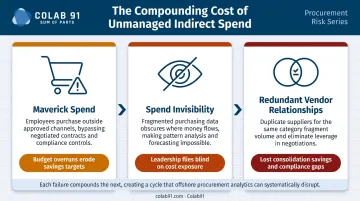
That fragmentation produces three compounding problems:
- Maverick spend - purchases made outside policy, on corporate cards, through auto-renewals, or directly with preferred vendors that no one formally approved
- Spend invisibility - data scattered across expense reports, AP systems, ERP exports, and departmental spreadsheets, with no consolidated view
- Redundant vendor relationships - multiple teams buying the same category from different suppliers, eliminating any volume leverage the organization might otherwise have
Why Governance Is Structurally Harder Here
Each of those three problems shares a root cause: indirect spend arrives through too many channels to govern consistently.
Direct spend follows a production schedule. You know what you're buying, when, and roughly how much. Indirect spend doesn't work that way. A facilities maintenance request, a one-off legal engagement, and a SaaS renewal that auto-processes on a credit card are all indirect purchases. They arrive through completely different channels, owned by different people.
That unpredictability makes policy enforcement genuinely difficult without a deliberate governance model. Most organizations manage it reactively - and unmanaged spend compounds quickly across categories.
McKinsey notes that advanced analytics in indirect procurement can reduce the manual effort required for supplier governance by 30% to 50%. The prerequisite is having the data infrastructure in place before analytics can do that work.
What Is a Category Strategy in Procurement?
A category strategy is a structured, multi-year plan governing how an organization sources, manages, and optimizes a specific group of related spend. It's distinct from a sourcing event in scope and duration.
Strategic sourcing is a discrete activity - you run a competitive process, select a supplier, and sign a contract. Category strategy is the ongoing discipline surrounding the entire spend area; sourcing is one periodic activity within it, not the whole thing.
What a Category Strategy Document Contains
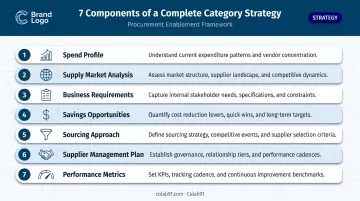
A complete category strategy typically covers:
- Current-state spend profile - who's buying what, from whom, under which contracts
- Supply market analysis - supplier concentration, pricing dynamics, switching costs, market trends
- Business requirements - what stakeholders actually need beyond price (speed, compliance, flexibility)
- Savings and value opportunities - identified gaps between current state and optimal sourcing
- Sourcing approach - competitive RFP, negotiation, sole-source, GPO, or spot buying
- Supplier management plan - how you track performance and govern supplier relationships
- Performance metrics - savings captured, compliance rates, supplier KPIs
Applying the 80/20 Rule to Category Prioritization
Not every indirect category deserves the same depth of effort. In most organizations, roughly 20% of indirect categories account for 80% of the spend and risk.
A simple 2×2 portfolio matrix - plotting spend volume against supply market complexity - tells you where to focus:
| Low Supply Complexity | High Supply Complexity | |
|---|---|---|
| High Spend | Negotiate and consolidate | Full category strategy |
| Low Spend | Automate or aggregate | Standardize and automate |
Categories in the upper right (high spend, high complexity - enterprise software, professional services, major facilities contracts) warrant a full multi-year strategy. Office supplies and low-value MRO items do not.
Strategy vs. Plan: A Common Confusion
These terms get used interchangeably, but the difference matters. The strategy sets multi-year direction - where you're taking the category and why. The plan translates that into a 12-month execution roadmap: specific sourcing events, supplier reviews, and contract milestones.
Both are necessary. Without a strategic foundation, annual plans devolve into a series of one-off sourcing events with no cumulative progress.
How to Build an Indirect Category Strategy, Step by Step
Category strategy development is iterative, not a one-time deliverable. The depth of effort scales with the category's spend and strategic importance.
Step 1: Build a Spend Profile
Everything starts with a clean, categorized view of what the organization is spending, with whom, under what contracts, and across which business units. Data sources include AP records, corporate card data, expense reports, and ERP exports.
Poor data taxonomy is the most common reason category strategies fail before they start. If spend is miscategorized or scattered across incompatible systems, you're building on an incomplete picture - and systematically underestimating both category size and supplier concentration.
Step 2: Conduct a Supply Market Assessment
A supply market assessment covers the external factors that shape your sourcing options:
- Number and concentration of available suppliers
- Switching costs and barriers
- Current pricing dynamics and market trends
- Regulatory or compliance factors specific to the category
This intelligence shapes the sourcing approach. A category with five viable suppliers and low switching costs warrants a competitive RFP. A category with one dominant vendor and high integration costs requires a different play.
Step 3: Define Business Requirements and Stakeholder Priorities
Category strategy must be anchored in what the business actually needs. Procurement teams that build strategies in isolation - optimizing purely for cost - regularly produce strategies that stakeholders route around.
Gather requirements from internal customers by asking:
- What do they value beyond price? (Speed of delivery, quality consistency, compliance, innovation support)
- What frustrates them about the current state?
- How do their operational goals translate into supplier performance requirements?
Requirements gathered here directly inform which sourcing approach to pursue in Step 4.
Step 4: Develop and Select a Sourcing Approach
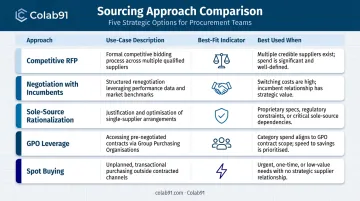
The sourcing approach should flow logically from the spend profile, market assessment, and business requirements - not from habit. Common options include:
- Competitive RFP - appropriate when multiple qualified suppliers exist and the spend justifies the process cost
- Negotiation with incumbents - useful when switching costs are high but pricing or terms need improvement
- Sole-source rationalization - consolidating volume behind a single preferred supplier in exchange for better pricing and service commitments
- GPO leverage - using a group purchasing organization's pre-negotiated contracts for categories where the organization lacks volume
- Spot buying - for tail spend and low-value, infrequent purchases
Re-evaluate the approach at each contract cycle - market conditions shift, and the method that worked three years ago may not reflect today's supplier landscape.
Step 5: Execute, Track, and Evolve
A category strategy only delivers value if it's implemented, measured, and updated. Ongoing category management includes:
- Quarterly supplier performance reviews against defined KPIs
- Savings tracking against baseline, not just against budget
- Compliance monitoring - are stakeholders buying through approved channels?
- Annual strategy refresh accounting for business changes and supply market shifts
Dedicated analytical capacity is what makes this ongoing work tractable. Colab91's offshore procurement analysts - built for mid-market and PE-backed companies - run spend analysis, supplier benchmarking, and contract compliance tracking as continuous functions rather than one-off projects.
The model pairs onshore procurement expertise with offshore delivery, so organizations get the analytical throughput needed to manage multiple categories simultaneously without a proportional increase in headcount.
Key Optimization Levers for Indirect Spend
Vendor Consolidation
When multiple business units use different vendors for the same category, the organization loses volume leverage and visibility simultaneously. Consolidation is often the highest-ROI move available.
To identify consolidation candidates:
- Map purchases of similar SKUs or services across business units
- Quantify pricing variance between vendors providing equivalent services
- Calculate total transaction cost, not just unit price
McKinsey data shows that intelligent spend analysis in consolidation contexts can yield 10% to 12% savings by identifying similar services and rationalizing vendor counts. The business case typically builds quickly once fragmentation is made visible.
Supplier transitions need to be sequenced carefully. Start with lower-risk categories, build credibility with stakeholders, then address more deeply embedded vendor relationships.
Continuous Spend Analysis
Consolidation decisions are only as good as the data behind them - which is why spend analysis needs to be continuous, not periodic. Run it regularly to surface:
- High-frequency, low-value purchases suitable for automation or aggregation
- Categories with expired or no active contracts
- Pricing inconsistencies across locations or business units indicating a lack of centralized governance
These patterns don't stay static. New spend walks through the door constantly, and without regular analysis, categories that were clean six months ago can develop new fragmentation.
Technology and Process Standardization
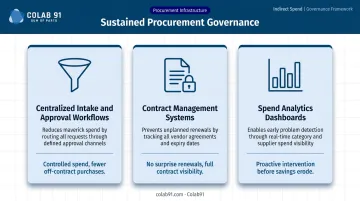
Sustaining these gains requires the right process infrastructure:
- Centralized intake and approval workflows reduce maverick spend before it happens
- Contract management systems prevent unplanned renewals that often carry list-price escalators
- Spend analytics dashboards give procurement leadership visibility to identify problems early
For mid-market companies that can't justify a full procurement technology stack, offshore capability centers with shared analytics infrastructure fill this gap. Colab91 builds dedicated India-based teams of procurement and spend analytics specialists, giving mid-market organizations the same analytical depth they'd expect from a large enterprise - without the overhead of building it in-house.
Common Pitfalls in Indirect Category Management
Three failure patterns account for most indirect category management breakdowns. They're distinct problems, but they often appear together - and each one compounds the others.
Treating It as a Cost-Cutting Exercise
One-time sourcing events deliver savings that erode quickly when category management processes aren't maintained. Suppliers negotiate back, stakeholders revert to preferred vendors, and new uncategorized spend enters the system.
The organizations that sustain gains treat category management as an ongoing operational capability - not a periodic savings sprint.
Building Strategy Without Stakeholder Buy-In
When procurement builds category strategies in isolation and then expects compliance, the business routes around it. The evidence shows up as:
- Shadow IT purchases that bypass approved channels
- Department-level agency relationships outside contracted suppliers
- Expense report spend that never touches a purchase order
The result: spend under management stays low, regardless of how sophisticated the strategy looks on paper.
Relying on Incomplete Spend Data
Both of the above problems are compounded when strategies are built on partial data. Spend profiles covering only 60–70% of actual spend underestimate category size, undervalue supplier relationships, and produce sourcing decisions based on a distorted market view.
Cleaning and classifying spend data before building strategy isn't optional - it's the foundation everything else depends on.
Conclusion
Managing indirect procurement categories well requires two things working together: a clear picture of what you're actually spending, and a deliberate strategy for how each category should be governed over time. The companies that do this well don't treat it as a project. They treat it as a capability.
For mid-market and PE-backed companies, the challenge is usually capacity, not intent. Building the analytical infrastructure, domain expertise, and dedicated resources to manage indirect categories strategically is a significant lift - one that most mid-market procurement teams can't absorb while managing everything else.
Colab91 builds dedicated India-based capability centers designed for this specific challenge. The leadership team brings 16+ years of hands-on experience scaling procurement and analytics organizations - including work with Carlyle Group, TPG, and PE-backed healthcare companies - and applies that background to help mid-market companies build enterprise-level procurement depth without the enterprise overhead.
If closing that capability gap is a priority, reach out to the Colab91 team to start the conversation.
Frequently Asked Questions
What are indirect categories in procurement?
Indirect categories are groups of related purchases that support business operations but aren't incorporated into the company's final product or service. Common examples include IT, travel, marketing, facilities, and professional services - essentially everything the organization needs to function, not to produce.
What is category strategy in procurement?
A category strategy is a structured, multi-year plan for how a specific group of spend will be sourced, managed, and optimized. It goes beyond a single sourcing event to encompass supplier management, stakeholder alignment, and ongoing performance monitoring across the full lifecycle of that spend area.
What is the 80/20 rule in procurement?
In most organizations, roughly 20% of procurement categories account for approximately 80% of total spend and risk. This principle guides where to invest strategic effort - high-spend, high-complexity categories warrant full category strategies, while low-spend categories can be managed through streamlined or automated buying processes.
What are the five procurement categories?
The five most common indirect spend categories are IT and software, travel and events, facilities and overhead, marketing and professional services, and MRO and office supplies. The exact taxonomy varies by industry and company size, but most organizations will recognize these groupings in their own spend data.
How is indirect procurement different from direct procurement?
Direct procurement covers materials and services built into the product sold to customers - raw materials, components, packaging. Indirect covers what the organization needs to operate. The two differ in ownership structure, supply market dynamics, and governance approach - direct tends to be centralized; indirect is typically distributed.
How do mid-market companies manage indirect procurement without a large in-house team?
Mid-market companies increasingly use offshore capability centers, group purchasing organizations, or hybrid models to access category expertise without building large internal teams. Colab91 addresses this directly: dedicated offshore teams of domain experts integrate with client operations, pairing onshore strategic direction with offshore delivery efficiency.