
The good news: India's GCC momentum is real and accessible at your scale. According to the Zinnov-NASSCOM FY2026 report, India now hosts 2,117 GCCs employing 2.36 million professionals and generating $98.4 billion in revenue - including 583 mid-market GCCs and 504 PE-backed centers. The model works at your size.
This guide covers what a GCC actually is, how to choose the right operating model, the step-by-step setup process, and the factors that separate productive centers from expensive experiments.
Key Takeaways
- A GCC is a company-owned India entity delivering core business functions - distinct from outsourcing or vendor arrangements
- India's STEM talent pipeline, government support, and cost structure make it the top GCC destination globally
- Operating model selection (Captive, BOT, or Hybrid) is the most consequential early decision for mid-market companies
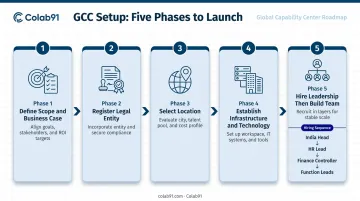
- Setup follows five phases: define scope → register entity → select location → build infrastructure → hire leadership
- Treating a GCC like a vendor relationship is the most common failure mode; success requires active governance and a long-term talent plan
What Is a GCC and Why Is India the Right Choice?
A Global Capability Center is a wholly or majority-owned offshore entity established by a multinational to deliver strategic business functions - technology, analytics, finance, procurement, R&D, or shared services - under the parent company's brand, processes, and governance.
The critical distinction from outsourcing: with a GCC, your company owns the team, controls the culture, and builds compounding institutional knowledge over time. Outsourcing delivers a service. A GCC builds a strategic asset. For PE-backed companies, that distinction directly affects enterprise value at exit.
Why India Specifically
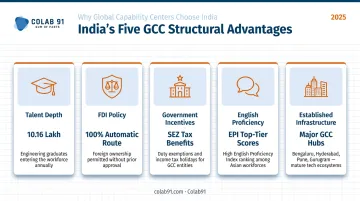
India's dominance as a GCC destination is driven by a set of structural advantages that reinforce each other:
- Talent depth: AISHE 2021-22 data records 10.16 lakh Engineering and Technology graduates annually, with 98.5 lakh STEM students enrolled across higher education
- FDI policy: DPIIT's Consolidated FDI Policy permits up to 100% FDI under the automatic route in sectors not otherwise restricted - which covers most IT/ITeS GCC structures
- Government incentives: SEZ units receive zero-rated IGST treatment on exports, single-window clearance, and income-tax exemptions under Section 10AA; states like Karnataka and Telangana have dedicated GCC policies with additional incentives
- English proficiency: India's EF EPI function scores are strongest in R&D (592), Strategy and Project Management (572), and Customer Service (531)
- Established infrastructure: India's legal, payroll, compliance, and technology infrastructure for GCC operations is well-developed across major hubs - including Bengaluru, Hyderabad, Pune, and NCR
The scale of GCC leasing activity reflects this momentum: CBRE reports GCC office leasing hit 29.4 million sq ft in CY2024, representing 37% of total office leasing across India's top nine cities and a 29% year-on-year increase.
Choosing the Right GCC Operating Model
Model selection must happen before location, hiring, or entity registration. The wrong model for your company's stage creates structural problems that are expensive to unwind.
There are three primary models:
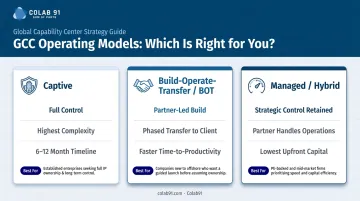
Captive Model
Your company registers the entity, builds all infrastructure, hires directly, and operates independently from day one.
- Best for: Large enterprises with dedicated India setup teams, high IP sensitivity, and multi-year timelines
- Trade-off: Full control comes with full complexity - entity registration, hiring infrastructure, compliance frameworks, and office setup all happen simultaneously
- Typical timeline: 6–12 months from decision to operational team
For most mid-market companies, the captive model demands internal bandwidth that simply doesn't exist.
Build-Operate-Transfer (BOT) Model
A specialized partner builds the entity, recruits the team, and manages operations for an agreed period - typically 12 to 36 months - before transferring full ownership to the parent company.
NASSCOM defines BOT as a model where a third-party partner builds and operates the GCC before transfer. Notably, Everest Group reports that around 50% of GCC launches in 2024 were assisted setups, reflecting how widely this model has been adopted.
- Best for: Mid-market companies that want eventual full ownership but lack the internal resources for a cold-start build
- Trade-off: Reduced initial risk and faster time-to-productivity, with a transition period to plan for
- Real example: Visualfabriq opened its Hyderabad GCC using a BOT model with partner Indigrators to accelerate its India product innovation hub
Managed / Hybrid Model
The company maintains strategic direction while a partner handles operational management, HR, compliance, and infrastructure. Teams reach productivity in weeks rather than quarters, with lower upfront capital requirements.
For mid-market and PE-backed companies without the internal resources for a cold-start build, this model removes the operational overhead without ceding strategic control. Colab91's "Sum of Parts" approach applies this structure - blending onshore domain expertise with offshore delivery to build teams that function as strategic hubs, not cost-reduction exercises.
Engagement models are flexible and scale-agnostic, covering entity ownership, IP rights, and strategic control from the outset. Managing Partners Madhur Kabra and Vijender Kapoor (both formerly of Impendi, acquired by Accenture) scaled a multifunctional India operation to 100+ practitioners serving PE sponsors including Carlyle Group, TPG, Elliott, and BC Partners - and that track record shapes how Colab91 structures engagements to avoid the setup mistakes that slow most first-time GCC builds.
How to Set Up a GCC in India: Step-by-Step
Regardless of operating model, setup follows a consistent sequence. The timeline compresses significantly with BOT or managed models, but the decision points remain the same.
Step 1: Define Scope, Functions, and Business Case
Before registering anything, answer these questions:
- Which functions move to India - technology, analytics, finance, procurement, customer operations?
- What does a 3–5 year headcount plan look like?
- What ROI or value creation metrics will the parent company measure?
- How will governance between HQ and India work?
A weak business case leads to underfunded GCCs that never reach critical mass. The business case also drives ongoing investment from HQ - it should define measurable outcomes, not just cost savings.
Step 2: Register the Legal Entity
Private Limited Company (Wholly Owned Subsidiary) is the most common GCC structure. It allows 100% foreign ownership in eligible sectors and gives the parent full operational control.
Alternatives exist but are limited in scope:
- Branch Office: Permitted for representing the parent and rendering professional services, within RBI-approved activities
- Liaison Office: Can act as a communication channel only - no commercial activity
Key registrations required:
| Registration | Authority | Notes |
|---|---|---|
| Company incorporation | MCA via SPICe+ | AGILE-PRO-S links GST, EPFO, ESIC |
| PAN and TAN | Income Tax Department | Required at incorporation |
| GSTIN | GST portal | Zero-rated for export services |
| EPFO and ESIC | Respective authorities | Mandatory employer contributions |
| FC-GPR filing | RBI | Within 30 days of share issuance to non-residents |
Two areas consistently trip up first-time GCC founders: FEMA compliance for equity reporting, and transfer pricing. International transactions between associated enterprises must be priced at arm's length under Indian tax law - get specialist advice before the first intercompany invoice.
Step 3: Select the Location
City selection should be driven by the talent profile you need, not just cost. Based on CBRE's CY2024 GCC leasing data:
| City | GCC Leasing Share (Q4 2024) | Primary Functional Demand |
|---|---|---|
| Bengaluru | 34% | Technology, software engineering |
| Hyderabad | 20% | IT, pharma R&D |
| Delhi-NCR / Gurugram | 12% | Analytics, consulting, finance |
| Pune | 10% | Engineering, manufacturing support |
| Chennai | 9% | Automotive, IT services |
| Ahmedabad, Kochi, others | 4% combined | Emerging cost-efficient alternative |
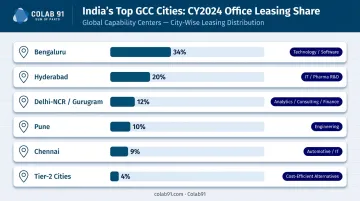
For functions like back-office finance, data processing, or customer operations, Tier-2 cities offer a real cost and attrition advantage - talent competition in Bengaluru and Hyderabad drives up both salaries and turnover.
Step 4: Establish Infrastructure and Technology
Physical setup options:
- IT park leased space (standard for established GCCs)
- Co-working or managed office space (practical for early-stage builds)
- Build-to-suit (for larger operations with defined long-term footprints)
Once the physical space is decided, technology and compliance setup runs in parallel. Key priorities:
- Cloud infrastructure and cybersecurity protocols aligned with HQ standards
- Data privacy compliance under India's DPDP Act 2023 - Rules were notified in November 2025 with an 18-month phased compliance timeline
- Integration with HQ ERP, collaboration, and reporting systems
BOT and managed model partners typically bring ready infrastructure, which compresses this phase considerably.
Step 5: Hire Leadership First, Then Build the Team
The India Head hire is the most consequential decision in the setup process. This person sets culture, manages local operations, and acts as the bridge between HQ and the India team. Under-invest here and you create a governance vacuum that affects everything downstream.
Hiring sequence:
- India Head / Country Manager (senior leader, not a mid-level manager)
- HR lead (critical early - drives all subsequent hiring)
- Finance controller (compliance and reporting from day one)
- Function leads aligned to scope defined in Step 1
Aon projects a 9.3% salary increase for GCC roles in India in 2026, up from 9.2% in 2025. Budget for this trajectory from the start - compensation models built on last year's benchmarks will cost you candidates.
Key Factors That Determine GCC Success
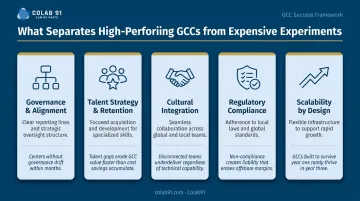
Most GCCs don't fail at setup. They fail in the months after - when governance gaps widen, attrition climbs, and the India team drifts from HQ priorities. These are the factors that separate high-performing centers from expensive experiments.
Governance and alignment - Set clear reporting lines, KPIs tied to parent company goals, and a fixed communication cadence: weekly operational reviews at minimum, quarterly strategic alignment sessions. Centers without structured governance drift from HQ priorities within months.
Talent strategy and retention - India's overall attrition rate declined to 16.2% in 2025 (Aon), but GCC talent markets in Bengaluru and Hyderabad remain competitive. Compensation is the floor, not the ceiling. Career development pathways, meaningful work, and a strong employer brand are what retain senior talent. Teams treated as execution-only turn over faster.
Cultural integration - Misalignment between HQ and India teams is one of the most frequently cited causes of GCC underperformance. Leadership exchange visits, shared operating rituals, and inclusive communication norms close that gap. Give the India team ownership over outcomes, not just tasks - that distinction matters more than most HQ leaders expect.
Regulatory compliance - India's compliance obligations stack up quickly: EPF (12% employer contribution), ESIC, GST, transfer pricing, FDI reporting, state-specific labor laws, and the evolving DPDP Act. Each layer applies simultaneously. Build a dedicated compliance function or retain specialized legal counsel from day one - not after an issue surfaces.
Scalability by design - The most resilient GCCs are built with growth in mind from the start: modular office space, scalable HR systems, and a hiring pipeline that runs continuously rather than restarting each cycle. Centers sized only for current headcount create predictable bottlenecks within 18–24 months.
Common Mistakes to Avoid When Setting Up a GCC in India
Most GCC setups don't fail because of bad intentions - they fail because of avoidable missteps in the early months. These four mistakes come up repeatedly:
Managing the GCC like a vendor relationship. Companies that measure only cost savings, not capability building, end up with low-engagement teams that function as expensive order-takers. A GCC is a strategic asset that requires investment in leadership, culture, and long-term talent development.
Appointing mid-level managers to lead India operations. This is one of the most common cost-cutting errors. The India Head needs the authority to make decisions and the credibility to represent the company's strategy locally - a mid-level hire rarely commands either.
Treating compliance as an afterthought. India's regulatory environment is manageable but layered. Companies that don't build their compliance framework alongside entity registration face audits, penalties, and avoidable delays.
Starting without a scale roadmap. GCCs that launch with 10–15 people and no growth plan tend to stagnate. Without critical mass, they can't attract senior talent or justify continued HQ investment. A 3-year headcount and capability plan should be part of the original business case.
Frequently Asked Questions
What is a GCC in India?
A Global Capability Center is a company-owned offshore entity set up in India to deliver core business functions - technology, analytics, finance, or procurement - under the parent company's brand and governance. Unlike outsourcing, the company owns the team, the IP, and the institutional knowledge.
How do you set up a GCC in India?
The setup follows five phases: define scope and business case, register the legal entity (typically a Private Limited/WOS), select a location based on talent requirements, establish infrastructure and technology, then hire leadership before building the broader team. Timeline depends on which operating model you choose.
How much does it cost to set up a GCC in India?
Costs vary by operating model, location, headcount, and function - with salary and benefits (EPF/ESIC, ~9.3% annual increases), office leasing, entity registration, and DPDP compliance as the primary drivers. BOT and managed models require less upfront capital than a fully captive build. Contact Colab91 for a tailored cost assessment.
How long does it take to set up a GCC in India?
A fully captive GCC typically takes 6–12 months from decision to operational team. BOT and managed models can compress this significantly by leveraging a partner's existing infrastructure, hiring networks, and compliance frameworks.
What is the difference between a GCC and outsourcing?
Outsourcing hands delivery - and institutional knowledge - to a third-party vendor. A GCC keeps the entity, the people, and the capability inside your company, making it a long-term strategic asset rather than a contracted service relationship.
Which cities in India are best for setting up a GCC?
The right city depends on your function. Bengaluru leads for technology (34% of GCC leasing), Hyderabad for IT and pharma R&D (20%), Delhi-NCR/Gurugram for analytics and consulting (12%), Pune for engineering (10%), and Chennai for automotive and IT services (9%). Tier-2 cities are emerging as cost-efficient alternatives for certain functions.