Introduction
Picture this: your CFO walks into a procurement review and asks a simple question—"Where are our cost savings coming from this quarter?" The room goes quiet. Someone opens a spreadsheet. Another person pulls up an email thread. A third checks a system that doesn't talk to the other two. Twenty minutes later, you have a partial answer.
This is the reality for many mid-market procurement teams, and it's exactly what procurement visibility solves.
Procurement visibility is the ability to access, track, and act on real-time data across the entire procurement lifecycle—from sourcing and supplier contracts to spend patterns and compliance. According to PwC's 2024 Global Digital Procurement Survey, only 44% of transactional procurement processes were digitalized in 2024, with companies targeting 70% by 2027. That 26-point gap translates directly into blind spots: maverick spend, missed savings, and supplier risk that doesn't surface until it's already a problem.
For mid-market and PE-backed companies, closing that gap isn't operational housekeeping. Procurement visibility is a direct lever for cost control, supplier risk management, and measurable savings—yet most organizations treat it as an afterthought. This guide breaks down what it actually takes to build it.
Key Takeaways
- Procurement visibility covers three dimensions: spend, process, and supplier/contract data—not just where money goes
- Higher digital maturity directly correlates with better cost savings and supplier performance outcomes
- Three barriers dominate: data fragmentation, talent gaps, and process inconsistency
- Moving from reactive (Stage 1) to integrated real-time visibility (Stage 3) is the primary maturity goal for mid-market companies
- Offshore analytical capability builds procurement visibility without the overhead of large in-house teams
What Is Procurement Visibility?
Procurement visibility means knowing, in real time, where money is going—which suppliers, which categories, under what contract terms, and at what compliance level—across every part of the organization. Not in next month's report. Now.
The Three Dimensions
Most definitions stop at spend tracking. That's too narrow. Real procurement visibility has three interconnected layers:
- What you're buying, from whom, in which categories, and at what price (spend visibility)
- How purchasing decisions move through approval workflows, requisition-to-purchase cycles, and onboarding steps (process visibility)
- Whether purchases align to negotiated terms and whether suppliers are meeting agreed SLAs (contract and supplier visibility)
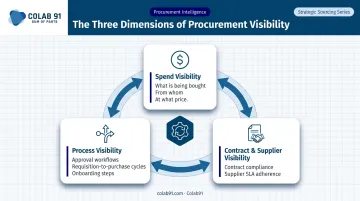
Strip out any one of these, and you have blind spots. A company can know exactly what it's spending but have no idea whether 30% of those purchases bypass contracted suppliers. That's spend data without contract visibility.
Procurement Visibility vs. Supply Chain Visibility
These two concepts are often conflated, but they operate in different domains.
Supply chain visibility tracks the physical flow of goods: shipments, inventory levels, logistics milestones, and fulfillment status. Procurement visibility focuses on the financial, contractual, and sourcing decisions that precede that flow — what was decided to buy, from whom, under what terms, and at what cost.
Both matter for operational resilience. Procurement visibility enables better decisions upfront; supply chain visibility helps you manage execution downstream.
What It Looks Like in Practice
Procurement visibility, when built properly, shows up as:
- Category-level spend dashboards accessible to both finance and procurement without manual report pulls
- Automated alerts for contract renewals, compliance deviations, or supplier concentration risks
- Supplier scorecards tracking delivery reliability, quality, and contract adherence—not just price
- Off-contract spend identified at the transaction level, not discovered in a year-end audit
Visibility is an internal operational capability: the ability to access and act on data within your organization. Transparency is what you choose to share externally. Visibility is what makes meaningful transparency possible in the first place.
Why Procurement Visibility Matters for Business Outcomes
Cost Control That Doesn't Wait for Quarterly Reviews
When procurement teams can see spending patterns across categories and departments in real time, they catch problems early. Off-contract purchases, consolidation opportunities, and budget overruns are visible before they compound—not six weeks after quarter close.
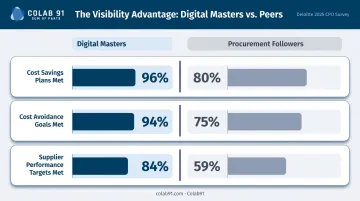
Deloitte's 2025 CPO Survey puts numbers to this: Digital Masters—organizations with higher procurement digitalization and visibility—met or exceeded their cost-savings plans at 96%, compared to 80% of less mature peers. For cost avoidance, the gap was 94% vs. 75%.
Those aren't marginal differences. For a mid-market company with $200M in third-party spend, that gap compounds across every category, every quarter.
Supplier Risk Surfaces Only When Data Is Centralized
Undocumented suppliers, expired contracts, and compliance gaps don't announce themselves. They surface when someone looks—and that only happens when data is centralized and monitored.
KPMG's 2024 Global Procurement Survey of 400 senior procurement professionals found that 67% do not rate their organization's third-party risk management as highly mature. That's a majority of procurement functions flying partially blind on supplier risk. For PE-backed companies managing multiple supplier relationships across portfolio companies, the exposure is multiplied.
Supplier Performance Decisions Require Data Beyond Price
Organizations with mature visibility evaluate suppliers across more than unit cost. The metrics that actually drive sourcing decisions include:
- Delivery reliability — on-time rates against contracted SLAs
- Quality performance — defect rates, return frequency, and incident history
- Contract adherence — pricing compliance, volume commitments, and certification status
Deloitte's same survey found Digital Masters met or exceeded supplier-performance targets at 84%, compared to 59% for followers. The 25-point gap reflects what centralized data makes possible: consistent evaluation criteria applied across every supplier relationship, not just the ones that already have problems.
Faster Answers for PE-Backed Leadership
CFOs and CPOs at PE-backed companies need rapid answers: savings realization against plan, supplier risk exposure by category, spend-under-contract percentages. Without visibility infrastructure, producing those answers requires analysts spending days on manual reconciliation.
McKinsey has noted that digital procurement tools in PE contexts can lift EBITDA by 20% within six months when spend transparency is established quickly. During a hold period where every quarter counts toward value creation targets, that compression of time-to-insight is itself a competitive asset.
Compliance and Audit Trails
For organizations under PE ownership or navigating regulatory requirements, procurement visibility provides an auditable trail of purchasing decisions, contract compliance rates, and supplier certifications. This supports both internal governance and investor reporting—capabilities that become essential during exit preparation or LP reviews.
Common Barriers That Block Procurement Visibility
Data Fragmentation
The most common barrier is also the most fundamental. Most mid-market companies have procurement data scattered across multiple ERPs, standalone spreadsheets, approval email chains, and supplier portals. Deloitte reports that 57% of CPOs cite siloed ways of working as a barrier to value delivery.
Without a consolidated data foundation, any visibility effort produces an incomplete picture. You might have category-level spend from one system and contract terms in another, with no automated connection between them.
The Human Capital Gap
Building and sustaining procurement visibility requires specific analytical skills. Most mid-market procurement teams don't have all of these capabilities in-house:
- Spend data classification and taxonomy management
- Supplier benchmarking and performance tracking
- Dashboard development and reporting
- Savings identification and tracking
PwC data shows 24% of companies seek external support for master data management and spend visibility, indicating that this analytical gap is common enough to be a structural issue, not an isolated one. The result: organizations either deprioritize visibility work or make decisions on incomplete, unclassified data.
Process Inconsistency
When purchasing workflows, approval hierarchies, and supplier onboarding processes vary across departments or business units, building a unified view of procurement activity becomes nearly impossible. Inconsistent processes produce inconsistent data—and inconsistent data produces unreliable insights, regardless of how sophisticated your analytics tools are.
That means any investment in dashboards or analytics tools hits a ceiling if the underlying processes feeding them aren't aligned first.
Proven Strategies to Improve Procurement Visibility
Centralize Procurement Data
A centralized procurement repository is the non-negotiable starting point. Whether through a dedicated spend analytics platform, an integrated ERP module, or a combination of both, all purchase orders, contracts, invoices, and supplier records need to flow into one system of record.
Colab91's AI-powered Spend Analytics platform is built around this principle: a unified data layer where spend is cleansed, classified to UNSPSC or client-specific taxonomies, and enriched with supplier diversity, ESG data, risk profiles, and contract terms.
The platform integrates with major procurement systems — Coupa, Ariba, Jaggaer, and GEP SMART — which matters when mid-market clients have existing technology investments they can't replace overnight.
Standardize Processes and Workflows
Centralizing data only works if the data entering the system is consistent. Standardizing procurement workflows — requisition-to-purchase, approval hierarchies, supplier onboarding — ensures that what flows into your system is comparable, complete, and usable.
PwC found that 62% of companies identify process transparency and traceability as key drivers of procurement digitalization investment. The companies that skip standardization and jump to analytics end up with dashboards built on unreliable inputs. The insight is only as good as the data underneath it.
Implement Real-Time Analytics and KPI Tracking
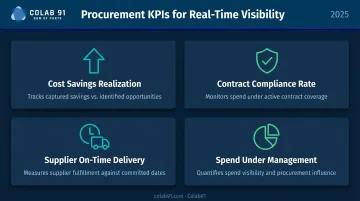
Real-time dashboards connecting spend data, contract terms, and supplier performance allow procurement and finance leaders to monitor KPIs without waiting for monthly reports. The metrics that matter most:
- Cost savings realization — tracked against negotiated targets, not estimated
- Contract compliance rate — percentage of spend aligned to contracted suppliers and terms
- Supplier on-time delivery — measured at the PO level, not through self-reported supplier data
- Spend under management — what percentage of total spend flows through governed procurement channels
Predictive analytics adds another layer — flagging anomalies before they escalate. A category showing unusual spend acceleration in week three of a quarter is addressable. The same pattern discovered in a quarterly review is a budget problem.
Build Dedicated Analytical Capability
Sustainable procurement visibility requires people who own the data. Spend analysts who classify spend accurately. Category managers who maintain supplier scorecards. Reporting specialists who translate raw data into actionable intelligence.
For mid-market companies that can't justify building a 10-person procurement analytics function in-house, offshore capability centers offer a practical alternative. Colab91 builds dedicated India-based teams covering spend cube construction, supplier benchmarking, contract compliance tracking, savings tracking, and ongoing procurement intelligence on weekly and monthly cadences.
The critical distinction from traditional outsourcing: these are domain-specialized teams, not generic back-office processors. Clients access them through flexible models — dedicated team, build-operate-transfer, or managed operations — depending on how much strategic control they want to retain long-term.
Connect Contracts to Actual Spend
Contract visibility is where strategic sourcing work either translates into realized savings or erodes undetected. Knowing what was negotiated is step one. Tracking whether actual purchases align to those terms is step two. Without that connection, negotiated savings disappear through maverick spend and auto-renewals that nobody flagged.
Colab91's Savings Opportunity Assessment specifically quantifies contract leakage and off-contract spend as part of its diagnostic — typically identifying 5–15% of addressable spend as recoverable within a 4–6 week engagement window. For most mid-market procurement teams, that's a material number hiding in plain sight.
How to Measure Your Procurement Visibility Maturity
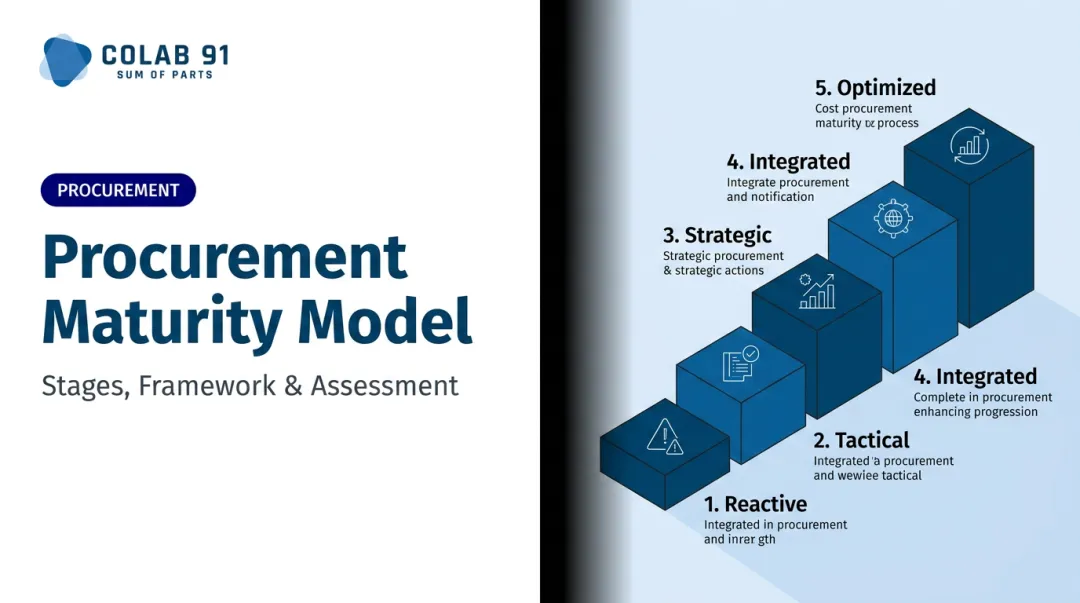
The Four-Stage Model
Most organizations sit somewhere on this progression:
| Stage | Label | What It Looks Like |
|---|---|---|
| Stage 1 | Reactive | Manual spreadsheets; basic spend questions take weeks to answer |
| Stage 2 | Descriptive | Basic procurement systems; reporting is backward-looking and periodic |
| Stage 3 | Predictive | Integrated, real-time data with automated alerts and KPI dashboards |
| Stage 4 | Prescriptive | AI-driven recommendations guide purchasing decisions proactively |
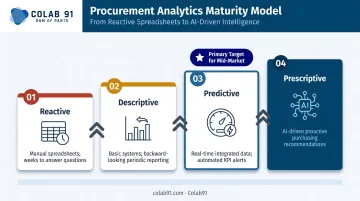
PwC's finding that only 44% of transactional procurement processes were digitalized in 2024 suggests a large share of mid-market companies remain at Stage 1 or early Stage 2. Moving to Stage 3 is the highest-leverage target—it doesn't require AI procurement recommendations; it requires reliable, connected, real-time data.
Baseline Metrics to Establish First
Before measuring progress, establish a baseline. These four metrics define where improvement investment will deliver the most value:
- Total active supplier count — Do you know how many suppliers you actually have?
- Percentage of spend under contract — What share of spend flows through negotiated agreements?
- Contract compliance rate — Of spend under contract, how much actually follows contracted terms?
- Percentage of spend visible through centralized systems — What's off-system entirely?
Answering these questions honestly is where most mid-market organizations discover their largest gaps. Colab91's Procurement Diagnostic is structured around all four, using an AI-augmented assessment completed in 4–6 weeks. The output is a category-by-category action plan with specific owners, targets, and timelines — not a slide deck, but a working execution roadmap.
Building the Business Case
Once you know where the gaps are, the financial case for closing them is concrete. Poor visibility carries quantifiable costs across several categories:
- Maverick spend that bypasses negotiated pricing
- Missed savings from contracts that aren't enforced or tracked
- Staff hours lost to manual reconciliation and reporting
- Disruption exposure from supplier issues that surface too late
Hackett Group research shows Digital World Class procurement organizations operate at 21% lower cost than peers — a $6 million advantage for a typical $10 billion company. At mid-market scale, the dollar figures are smaller, but the margin impact is often larger.
For most mid-market companies, moving from Stage 1 to Stage 3 is a 12–18 month effort with the right data infrastructure and category expertise in place. The baseline metrics above tell you how far you actually are from that target.
Frequently Asked Questions
What is visibility in supply chain?
Supply chain visibility tracks the physical movement of goods, logistics milestones, and fulfillment across supplier networks—what happens after purchasing decisions are made. It differs from procurement visibility, which focuses on the financial, contractual, and sourcing decisions that govern what gets bought and from whom.
What is procurement visibility?
Procurement visibility is real-time access to data across the entire procurement lifecycle—spend, contracts, suppliers, and processes—enabling organizations to make faster, more informed decisions and maintain compliance. It answers questions like: what are we buying, from whom, under what terms, and are we actually following those terms?
How does procurement visibility differ from spend visibility?
Spend visibility is one component of procurement visibility, focused specifically on where money is going and in which categories. Procurement visibility also encompasses process transparency, contract compliance monitoring, and supplier performance tracking. You can have detailed spend data and still lack meaningful procurement visibility if contracts and supplier performance aren't connected to it.
What are the biggest benefits of procurement visibility for PE-backed companies?
The core benefits are faster savings identification, cleaner audit trails for investor reporting, improved supplier leverage through data-backed renegotiations, and the ability to quickly benchmark procurement performance across portfolio companies. McKinsey has linked procurement spend transparency to EBITDA improvements of 20% within six months in PE contexts.
What tools or approaches help build procurement visibility?
Centralized spend analytics platforms, integrated ERP and contract management systems, and supplier performance dashboards are the core building blocks. Mid-market companies that can't justify large in-house teams often turn to offshore analytical capability—Colab91 builds dedicated procurement analytics teams for PE-backed and mid-market clients—covering spend classification, supplier benchmarking, and continuous intelligence without expanding fixed headcount.
How long does it take to improve procurement visibility?
A structured diagnostic can deliver centralized data and a spend baseline in 4–6 weeks, with standardized workflows and KPI dashboards following within 90–120 days. Full predictive visibility—real-time alerting and supplier risk monitoring—generally requires 6–18 months depending on starting data quality and organizational complexity.