
Offshore developer hiring has moved from a cost-cutting workaround to a deliberate growth strategy. Done correctly, it gives founders access to a larger talent pool, faster team assembly, and development capacity that scales with the product rather than the hiring budget.
This guide is for startup founders, PE-backed company leaders, and mid-market CEOs who need to build or scale a software team - and who want a model that actually integrates into their business, not just delivers code. It covers what offshore hiring really means, how the process works step by step, what separates successful engagements from failed ones, and where founders consistently go wrong.
Key Takeaways
- Offshore developers are full-time engineers based in lower-cost countries, most commonly India
- For founders building long-term products, a dedicated offshore team outperforms freelancers or one-off project outsourcing
- India combines the world's largest STEM talent pool with strong technical English proficiency and competitive salaries
- Success requires the right partner, solid legal agreements, and active management - talent alone isn't enough
- Three costly mistakes to avoid: chasing the lowest rate, skipping IP/NDA documentation, and treating offshore as a hands-off vendor
What Hiring Offshore Developers Really Means for Founders
Offshore developer hiring is the practice of engaging software engineers based in another country - through a vetted partner or capability center - to work exclusively on your product. The key phrase is "exclusively on your product." This is not a vendor executing a fixed project scope. When structured correctly, the offshore team operates as a true extension of your in-house team, with the same product context, planning visibility, and accountability expectations.
The Three Models Founders Encounter
Most founders encounter three engagement structures, and the differences matter significantly:
| Model | Structure | Best For |
|---|---|---|
| Staff Augmentation | Individual developers slot into your existing team under your direct management | Companies with an internal tech lead who can manage additional developers |
| Dedicated Offshore Team | Standalone, fully integrated unit aligned to your product goals | Founders building complex, long-term, evolving products |
| Project-Based Outsourcing | Fixed-scope delivery with minimal ongoing involvement | Narrow, well-defined deliverables with clear exit criteria |
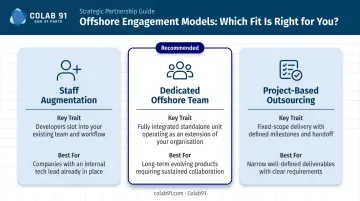
For most founders reading this guide, dedicated offshore teams are the right default. Project-based outsourcing works for isolated tasks, but it generates no institutional knowledge. Every new engagement starts from scratch. Staff augmentation works when you already have a strong internal tech lead, but falls apart when that internal leadership is exactly what you're trying to build.
That distinction matters because offshore hiring is frequently confused with something far less structured. It is not posting on Upwork, contracting a freelancer for a single feature, or engaging a low-accountability vendor to deliver a black-box result. Colab91's model, for example, addresses this directly - building dedicated offshore teams with defined engagement structures that cover entity ownership, IP rights, and scalability from the outset.
Why Founders Are Turning to Offshore Developers
The structural pressure is straightforward. CompTIA reported 37,180 new US job listings for software developers and engineers in August 2025 alone, with 29% of those postings specifically seeking candidates with four to seven years of experience. Experienced engineers - the ones who can lead architecture decisions and onboard junior developers - are both the hardest to hire and the quickest to move on when a better offer surfaces.
The Cost Gap
The salary differential between US and India-based senior engineers is substantial. Based on Glassdoor data:
- US Senior Software Engineer: ~$206,000 median total annual compensation
- Bengaluru Senior Software Engineer:
₹2.2M median total annual compensation ($26,000 USD equivalent) - Hyderabad Senior Software Engineer:
₹1.2M median total annual compensation ($14,000 USD equivalent)
These are employee salary benchmarks, not vendor bill rates - actual offshore engagement costs will include partner fees and management overhead. But the gap illustrates why the same engineering budget deployed offshore can build a multidisciplinary team rather than a single US hire.
What Offshore Uniquely Unlocks
Beyond cost, offshore hiring gives founders capabilities that domestic hiring structurally cannot:
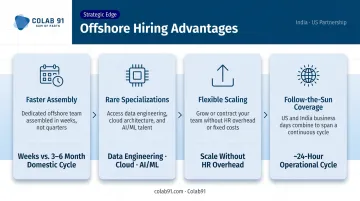
- A functioning team in weeks, not the 3–6 month domestic hiring cycle typical for senior roles
- Access to specializations that are locally scarce: data engineering, cloud infrastructure, AI/ML
- Scale up or down without the legal and HR overhead of direct employment
- Follow-the-sun coverage when designed correctly - the US and India business days combined span most of a 24-hour cycle
How to Hire Offshore Developers: A Step-by-Step Process
Step 1: Define Technical Scope Before Any External Conversations
Document what you're building, which roles you need (frontend, backend, DevOps, QA, data engineering), the required tech stack, estimated timeline, and budget constraints. This step is internal and must be completed before you approach any partner.
Vague requirements are the single leading cause of mismatched hires and expensive ramp-up delays. A partner can help you refine scope - but they can't build it from scratch.
Step 2: Choose the Right Engagement Model for Your Stage
- Dedicated team: best for long-term products with evolving requirements
- Staff augmentation: best when you have an existing tech lead and need execution capacity
- Project-based: best for narrow, well-scoped deliverables with a clear end state
If you're uncertain, default to the dedicated team model. The cost of rebuilding context after a project engagement ends usually outweighs any short-term savings.
Step 3: Select a Partner With Rigor
A strong offshore partner does more than fill seats. Look for:
- Transparent candidate screening with documented criteria
- Domain expertise relevant to your product
- References from companies at a similar stage
- The ability to help design your operating model, not just execute recruitment
India stands out for US-based founders for several concrete reasons. NASSCOM reports 2.14 million STEM graduates annually, placing India second globally after China. The country's offshore delivery ecosystem has matured significantly, with 1,800+ Global Capability Centers generating $64.6B in revenue.
English proficiency among IT professionals in tech hubs like Bengaluru (569) and Mumbai (570) consistently tracks above the global average - a practical factor that matters in distributed teams.
Colab91 operates from Gurugram and works with mid-market and PE-backed companies specifically. Its leadership built and scaled Impendi's India operations to 100+ practitioners serving clients including Carlyle Group and TPG before founding Colab91 to apply that model at the mid-market level.
Step 4: Vet Developers Even Through a Trusted Partner
Even when working with a vetted partner, founders should:
- Participate in or review technical interviews for senior and lead roles
- Assign a short paid technical assessment
- Evaluate communication quality and async work habits alongside coding ability
- Confirm the candidate has experience working across time zones
Step 5: Establish Legal Foundations Before Code Is Written
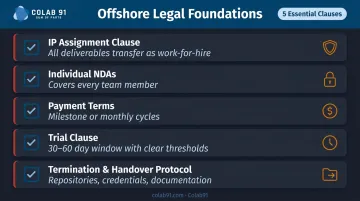
Every offshore engagement requires:
- IP assignment clause: all deliverables transfer to you explicitly under work-made-for-hire language
- Individual NDAs covering every team member, not just the partner firm
- Payment terms structured around milestones or monthly cycles
- Trial clause covering the initial 30–60 days with clear performance thresholds
- Termination and handover protocol specifying what happens to repositories, credentials, and documentation
This step is frequently skipped or rushed by first-time offshore founders. For any company with investor-facing IP obligations, a SaaS product with proprietary algorithms, or pending patent applications, skipping it creates serious exposure. A serious offshore partner will treat this documentation as standard practice, not an obstacle.
Step 6: Onboard With the Same Rigor as an Internal Hire
On day one, the offshore team should have:
- Product architecture documentation and coding standards
- Roadmap context and current sprint goals
- Access to collaboration infrastructure (Jira, Slack, GitHub, Notion)
- Introductions to internal stakeholders through a structured kickoff call
Establish a predictable communication cadence from the start: daily standups, sprint planning and retrospectives, and monthly performance reviews. The teams that ramp fastest are the ones given context on the why, not just the what.
Key Factors That Determine Offshore Hiring Success
Documentation Quality
The most reliable predictor of offshore team performance is the quality of written context the founder provides. Vague briefs generate vague output. Founders who invest in detailed specifications, user stories, and architecture documentation before onboarding see faster time-to-productivity and fewer rework cycles. Of all the variables in an offshore engagement, documentation quality is the one most directly within a founder's control.
Time Zone Management
India-based teams operate on a 10–12 hour offset from US time zones. This requires deliberate workflow design, not improvisation:
- Establish a 2–4 hour daily overlap window for synchronous communication and decision-making
- Build async documentation practices so work continues on both sides without blocking handoffs
- Use tool-driven status updates (Jira, Notion, Loom) to maintain momentum across the full day
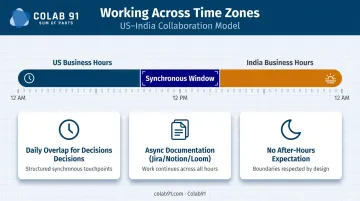
Requiring India-based developers to routinely stretch into US evening hours is a retention risk. Output quality also degrades over time when the schedule isn't sustainable.
Cultural Integration
Offshore developers who understand the product mission and participate in planning produce better code and stay longer. The specific recommendation: include offshore team members in sprint reviews, product demos, and quarterly roadmap sessions. Ticket assignments alone aren't enough - when developers understand why a feature matters, the independent decisions they make during implementation improve noticeably.
Retention and Team Stability
Developer churn destroys institutional knowledge and is expensive to recover from. Gallup estimates employee replacement costs between 50% and 200% of annual salary - and that's for general employees, not specialized software engineers whose context takes months to rebuild. When evaluating offshore partners, ask directly about their developer compensation practices and historical retention rates. This is due diligence, not an afterthought.
Operating Model Over Headcount
The most successful offshore engagements treat the offshore team as a strategic capability hub. Colab91's "Sum of Parts" approach embodies this: blending onshore domain expertise with offshore execution capacity so teams contribute to product strategy and architecture decisions, not just sprint delivery. How you frame the offshore team's role shapes how it's onboarded, how it communicates, and the quality of what it ships.
What Founders Get Wrong About Offshore Hiring
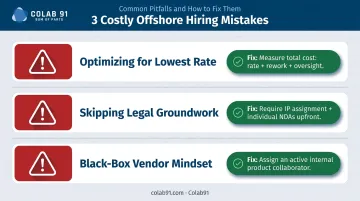
Optimizing for the lowest hourly rate. The most common and costly mistake. Low-cost, unvetted developers without strong English communication skills, domain context, or quality standards generate more rework and management overhead than they save. The correct metric is total cost of engagement: developer rate plus onboarding time, rework cycles, and ongoing management load. A developer at a higher rate who requires minimal oversight and produces clean, documented code is almost always cheaper in practice.
Skipping or rushing the legal groundwork. Many founders - particularly at seed and Series A stage - treat NDAs and IP assignments as bureaucratic friction. The specific risk: if your product includes proprietary algorithms, your SaaS platform has investor-facing IP obligations, or you're approaching a patent application, undocumented offshore code contributions create real legal exposure. Any serious offshore partner will expect and support this documentation as standard onboarding practice.
Treating the offshore team as a black-box service. Founders who assign work and wait for results without maintaining active involvement consistently report poor outcomes. The offshore team needs ongoing product context, directional input, and leadership visibility from the founder's side. The founder or a designated internal product lead must act as an active collaborator - not a passive client. Active collaboration from the founder's side is what makes this model work.
Frequently Asked Questions
How do you hire an offshore development team?
Start by defining your technical scope, required roles, and engagement model internally. Then select a vetted offshore partner in a location like India, conduct rigorous technical and communication interviews, sign IP assignment and NDA agreements, and establish a structured onboarding and communication plan before the team begins work.
How much does it cost to hire dedicated offshore developers?
Costs vary by region and seniority. India-based senior developers typically cost $14,000–$26,000 USD annually - compared to ~$206,000 median total compensation for a US senior engineer. Factor in partner management fees, onboarding investment, and communication infrastructure for a complete picture.
What's the difference between an offshore developer and a dedicated offshore team?
Individual offshore developers are typically hired through freelance platforms for short-term tasks with limited accountability and no product continuity. A dedicated offshore team is a structured, long-term unit working exclusively on your product - integrating with your internal workflows and carrying cumulative context across the product lifecycle.
Why is India a strong choice for offshore development?
India produces 2.14 million STEM graduates annually and hosts over 1,800 Global Capability Centers. English proficiency among IT professionals in major tech hubs - Bengaluru, Hyderabad, Mumbai - tracks consistently above global averages. Combined with competitive salary benchmarks and decades of offshore delivery experience for global enterprises, India offers a combination no other market matches at scale.
What are the biggest mistakes founders make when hiring offshore developers?
Three stand out: choosing based on the lowest rate rather than total fit and quality, skipping IP assignment and NDA documentation, and failing to actively integrate the offshore team into the product development workflow. All three are avoidable - but only if you address them before signing a contract.
How do I protect my IP when working with offshore developers?
Your MSA should include an explicit IP assignment clause (all deliverables are work-for-hire owned by you), individual NDAs signed by every team member, and a prohibition on using your codebase for any other client. A qualified offshore partner treats all of this as standard practice.