Pricing varies enormously. A mid-market best-of-breed analytics tool and a full AI-native source-to-pay suite can differ by $500K+ annually, and those aren't the same product. Misreading the cost structure leads to one of two failure modes: underinvesting in a reporting tool when strategic intelligence is needed, or overbuying a full suite when a focused analytics layer would deliver faster ROI at a fraction of the cost.
This guide breaks down 2026 pricing tiers, the key cost drivers that move the needle, and the full cost of ownership beyond the license fee — so procurement leaders and CFOs can budget accurately before entering a vendor negotiation.
Key Takeaways
- Annual costs range from ~$30K–$80K for mid-market best-of-breed tools to $1M+ for full enterprise AI-native suites
- The license fee is typically only 40–60% of first-year total cost — implementation, integration, and services make up the rest
- AI and agentic features sit in higher pricing tiers and are rarely priced transparently
- Reported savings of 5–15% of addressable spend depend heavily on platform utilization and analyst capacity
- Lean teams bridge the cost-to-value gap by pairing a mid-range tool with offshore domain expertise
How Much Does an Enterprise Spend Intelligence Platform Cost?
Unlike off-the-shelf software, enterprise spend intelligence platforms rarely publish fixed prices. Costs vary based on:
- Spend volume under management
- Data complexity and number of ERP sources
- Number of users and analytics depth
- AI feature set and deployment model
The market separates into three distinct tiers.
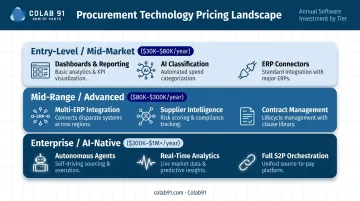
Entry-Level / Mid-Market Best-of-Breed: $30K–$80K/Year
What's typically included:
- Cloud-based spend visibility with pre-built dashboards
- AI-assisted spend classification against UNSPSC or custom taxonomies
- ERP connectors (SAP, Oracle, NetSuite)
- Basic supplier enrichment and self-service analytics
Representative platforms: Ignite publishes a starting price of approximately $1,400/month USD (15,000 NOK/month). Tropic's 2026 glossary states mid-market spend analytics platforms typically run $36K–$75K/year, putting the $30K–$80K band in line with published market data for best-of-breed tools.
Best for: Mid-market companies on one or two ERP sources, moving off spreadsheets. First insights typically arrive within 4–8 weeks of deployment.
When those requirements outgrow entry-level tools — multiple geographies, richer supplier data, or early AI workflows — the mid-range tier picks up where basic visibility leaves off.
Mid-Range / Advanced Spend Intelligence: $80K–$300K/Year
What's typically included:
- Multi-ERP integration with higher-accuracy AI classification
- Supplier intelligence and savings tracking
- Contract intelligence and ESG data enrichment
- Limited agentic AI features
Representative platforms: Ivalua's Capterra listing shows $150,000/year, supported by Forrester's Ivalua TEI study which models $1.4M in full S2P license fees over three years. GEP and Zycus operate in this tier but require quote-based pricing.
Best for: Larger procurement organizations managing indirect and direct spend across multiple geographies, needing category management workflows and deeper supplier analytics.
Organizations running full procurement transformation — or PE-backed platforms consolidating across portfolio companies — typically need the capabilities and integrations that only the enterprise tier delivers.
Enterprise / AI-Native Full Suite: $300K–$1M+
What's typically included:
- Full source-to-pay orchestration
- Autonomous AI agents for workflow execution
- Real-time (not batch) analytics with anomaly detection
- Contract intelligence, savings tracking automation, and ESG intelligence
Representative platforms: Coupa, SAP Spend Control Tower, and Suplari (acquired by Microsoft in 2021 and now operating within the Microsoft Supply Chain ecosystem). All require quote-based pricing — Coupa and SAP publish strong AI capability evidence but not clean enterprise license pricing.
Best for: Fortune 500 and global enterprises with complex multi-ERP environments, or PE-backed organizations running full procurement transformation programs.
Key Factors That Affect the Cost of Enterprise Spend Intelligence
Pricing isn't just about feature tiers. Several technical and organizational factors can shift a quote significantly from one deployment to the next.
Spend Volume and Data Complexity
Most vendors don't publish a clean spend-volume pricing schedule. SAP Spend Control Tower is quote-based — the closest public SAP pricing evidence is the Ariba Network's 0.155% supplier transaction fee, which is not Spend Control Tower buyer-license pricing. Ivalua's G2 listing is more specific: pricing is based on objects rather than volume, which matters for budget modeling.
Data complexity drives cost just as much as volume. Sievo describes implementations ranging from "several weeks to a few months depending on the number of data sources and IT infrastructure."
Organizations with multi-currency, multi-entity environments or poor underlying data quality should budget for longer timelines and higher services costs — regardless of tier.
Number of ERP and Data Source Integrations
Each additional ERP system, AP platform, or data warehouse adds cost — either through connector fees, professional services, or extended implementation timelines. Companies that have grown through acquisition and carry fragmented data environments face the highest exposure here.
A single-ERP environment and a five-system post-merger environment may fall in the same platform tier but carry very different total costs.
AI Feature Depth and Agentic Capabilities
Beyond integration scope, there's a meaningful distinction between AI-assisted classification and fully autonomous AI agents. Zycus reports up to 97% classification accuracy for companies using agentic AI, and its Merlin ANA agent targets autonomous negotiation capabilities. SAP publishes automated UNSPSC classification using feedforward neural networks. Neither discloses a specific price premium for these AI tiers in public materials.
Gartner predicts that over 40% of agentic AI projects will be canceled by end of 2027 due to escalating costs, unclear value, or inadequate risk controls. Buyers evaluating agentic tiers should require defined use cases, measurable outcomes, and payback gates before committing.
Deployment Model: Best-of-Breed vs. Suite
| Factor | Best-of-Breed Analytics | Full S2P Suite |
|---|---|---|
| License cost | Lower ($30K–$150K) | Higher ($300K–$1M+) |
| Implementation time | 4–16 weeks | 12+ months |
| Professional services | $15K–$75K | $200K–$500K+ |
| Integration complexity | Moderate | High |
| Time-to-first-value | Weeks | Quarters |
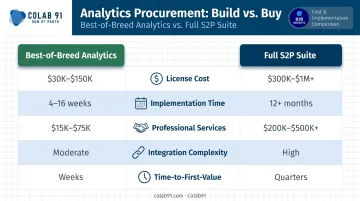
Best-of-breed tools like Ignite, Sievo, or Tropic carry lower licensing costs but require integration with existing procurement systems. Full suites bundle analytics but front-load implementation cost and timeline.
User Count and License Structure
Some platforms price by named users, others by concurrent users, and some offer unlimited-user enterprise licenses. Viewer-only licenses for finance stakeholders can add unexpected cost if not scoped upfront.
Confirm whether the quote distinguishes between procurement users and finance/executive viewers — that distinction changes the math on broader rollouts.
The Full Cost Breakdown: Beyond the License Fee
The annual platform fee typically represents only 40–60% of the true first-year cost of an enterprise spend intelligence deployment. Ignoring the rest is the most common budgeting mistake in procurement technology.
Platform License / Subscription Fee
Billed annually, with most enterprise contracts requiring 2–3 year commitments. Multi-year deals typically carry 10–20% discounts but reduce flexibility if the platform underperforms.
Implementation and Onboarding
A one-time cost covering:
- Data ingestion and ERP connector configuration
- Taxonomy setup and initial spend classification
- Internal project management and IT resources
For standalone tools, expect $15K–$75K. For full S2P suites, Forrester's Ivalua TEI composite models $100K in professional services and $150K in internal implementation cost — a $250K baseline before scope expands.
Data Integration and Ongoing Data Management
An ongoing cost that often surprises first-time buyers. Maintaining accurate spend data requires ERP refreshes, deduplication, taxonomy updates, and currency normalization. Platforms with stronger AI classification reduce this burden — but they don't eliminate it.
Professional Services, Consulting, and Change Management
Many enterprises layer strategic sourcing and analytics consulting on top of the platform. GEP's model bundles software, strategy consulting, and managed services into a single engagement — standalone platforms require external expertise, billed separately.
This is also where costs are most controllable. Colab91's Gurugram-based procurement analysts work as an extension of lean US procurement teams, running the analytical workload that platforms generate at roughly 40–60% of what onshore consulting firms charge for comparable depth.
Training, Adoption, and Support Costs
Licensing tier often determines support SLA quality, and the gap between tiers is significant. Platforms with steeper learning curves — SAP Ariba and Ivalua among them — carry higher training and change management costs than modern UX-focused tools. Internal adoption programs are rarely scoped into the initial budget and consistently underestimated.
Together, these five cost categories define the real TCO of a spend intelligence platform — and understanding each one is the starting point for a defensible business case.
Budget Platforms vs. Premium Platforms — What's the Real Difference?
The gap between a $40K/year best-of-breed tool and a $500K/year enterprise AI suite isn't just features — it's the depth of intelligence and the scale of outcomes achievable.
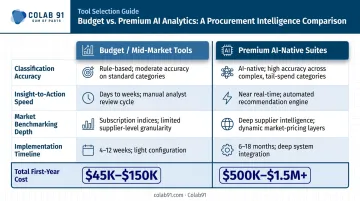
| Dimension | Budget / Mid-Market Tools | Premium AI-Native Suites |
|---|---|---|
| Classification accuracy | Good; may require manual taxonomy work | AI-driven, 90–97% automated accuracy claimed |
| Insight-to-action speed | Surfaces dashboards; humans act | Workflow agents route and execute actions autonomously |
| Market benchmarking depth | Analyzes your own spend only | Benchmarks against large external datasets (Tropic claims $20B+ in transaction data) |
| Implementation timeline | 4–16 weeks to first value | Months to 12+ months for full rollout |
| Total first-year cost | $45K–$150K all-in | $500K–$1.5M+ all-in |
Those cost differences only matter in the context of what they return. Suplari's 2026 procurement ROI guide puts industry savings rates at 5–15% of addressable spend, but flags realization losses as the gap between identified savings and what actually hits the P&L. When building a business case, model conservative realized savings — not the identified savings figure.
Platform selection ultimately comes down to fit: a $150K mid-market tool deployed against a well-scoped spend base can outperform a $1M suite deployed before the organization is ready to act on its outputs. Match the platform's capabilities to your procurement maturity and the size of the savings opportunity — not to vendor prestige.
How to Estimate the Right Budget (and Avoid Costly Mistakes)
Effective budgeting starts with understanding your data environment and expected value — not the vendor's list price.
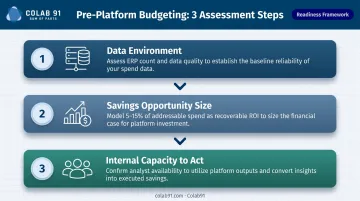
Assess These Before You Budget
- Data environment — How many ERP/AP systems need connecting, and how clean is the underlying data? Poor data quality inflates implementation cost and delays time-to-value regardless of platform quality.
- Savings opportunity size — If addressable third-party spend is $200M+, a $150K/year platform that unlocks 3% savings delivers a strong return. A savings opportunity assessment typically quantifies 5–15% of addressable spend as recoverable — giving you the ROI case before committing to a license.
- Internal capacity to act — A sophisticated AI platform only delivers value if category managers or analysts are using it. Without that capacity, companies overpay for features that sit idle.
Common Mistakes to Avoid
- Budget for total deployment cost, not just the license — implementation, integration, and change management routinely exceed year-one license fees on complex rollouts
- Insist on a POC with your actual spend data, not vendor-curated datasets; classification accuracy degrades significantly on real-world messy data
- Avoid paying for full S2P suite capabilities you won't use — a best-of-breed analytics layer on your existing stack often delivers faster ROI at lower cost
The Hybrid Model for Lean Teams
Organizations with lean procurement functions should consider pairing a mid-range platform with offshore domain expertise. Colab91's India-based spend intelligence capability centers provide dedicated procurement and analytics analysts operating on a continuous cadence — delivering weekly or monthly intelligence packages, board-ready reports, and category-level deep dives — without the overhead of an onshore analytics team.
The platform handles data infrastructure. The analysts handle the category-level analysis that converts clean data into negotiated savings.
Frequently Asked Questions
How much does business intelligence software cost?
Enterprise spend intelligence platforms — a more specialized category than general BI — typically start at $30K–$80K/year for mid-market deployments and can exceed $500K–$1M for full AI-native suites. Total first-year costs run higher once implementation fees and professional services are added.
What is the typical pricing model for enterprise spend intelligence platforms?
Most platforms use an annual SaaS subscription, sometimes tiered by spend volume or number of users. GEP bundles software with consulting and managed services into a single engagement fee. In contrast, best-of-breed tools tend toward a flat annual license with optional add-on modules for advanced capabilities.
What factors drive the price of an enterprise spend intelligence platform up or down?
The biggest cost drivers are the number of ERP and data source integrations, spend volume and data complexity, AI and agentic feature depth, deployment model (best-of-breed vs. full suite), and whether managed services or consulting are included in the engagement.
How long does implementation take and what does it cost?
Best-of-breed analytics tools typically deploy in 4–16 weeks with implementation costs in the $15K–$75K range. Full S2P suites take longer and cost substantially more — Forrester's Ivalua TEI study models $250K in services and internal costs alone. Data quality and the number of source systems are the primary timeline drivers.
What ROI should companies expect from a spend intelligence platform?
Industry benchmarks typically cite savings of 5–15% of addressable spend, though realized P&L impact is lower after realization losses. Platforms with AI agents and autonomous workflows tend to identify and act on savings faster than passive reporting tools.
Is it more cost-effective to choose a best-of-breed analytics tool or a full source-to-pay suite?
For most mid-market companies, best-of-breed tools deliver faster time-to-value at lower cost when analytics is the primary need. Full suites make sense when replacing sourcing, contracting, and procurement execution tools as part of a broader transformation. Many organizations successfully run a best-of-breed analytics layer on top of an existing suite rather than replacing it entirely.