The pressure is real. Mid-market and PE-backed companies face talent shortages in their home markets, rising labor costs, and the need to demonstrate operational scale without proportional headcount growth. More than 70% of CPOs reported difficulty attracting talent over a recent 12-month period, and US operations research analysts now command a median wage of $91,290 annually - with demand projected to grow 21% by 2034.
Offshoring solves both problems, but only when built deliberately. This guide covers the full framework: defining scope, choosing a location, structuring your team, onboarding, integration, and long-term performance management.
Key Takeaways
- Define your operating model before you hire: scope, authority, and success metrics all come first
- India offers the deepest talent pool for procurement, analytics, and finance functions, with 1,700+ GCCs already operating there
- The anchor hire (local team lead) is your most important early decision
- Integration requires deliberate design - build in scheduled overlap, shared tooling, and real cultural investment from the start
- Retention starts on day one - India's attrition averaged 16.2% in 2025, and replacing a trained domain expert costs far more than keeping one
What Is an Offshore Team?
An offshore team is a group of professionals in another country who work as a functional extension of your organization - not a vendor you hand work to and check in with monthly.
That distinction matters more than most companies realize before they start.
Offshore vs. Outsourcing: The Key Difference
Outsourcing: A third party handles a function independently. They own the process, set their own standards, and deliver outputs. You have limited visibility and no direct management.
Offshore team: Your people, in another country. They attend your standups, use your systems, report to your managers, and carry your culture. The relationship looks like employment, not procurement.
This difference determines everything about how you hire, onboard, and manage.
The Three Delivery Models
| Model | Geography | Best For |
|---|---|---|
| Onshore | Same country | Regulatory-sensitive roles, executive functions |
| Nearshore | Adjacent time zone (e.g., US to Latin America) | Real-time collaboration needs, moderate cost savings |
| Offshore | Different region (e.g., US to India) | Maximum cost differential, deep talent pools, scalable builds |
Offshore requires more deliberate communication management, but it delivers the largest talent and cost advantages of any model. Today's offshore teams extend well beyond IT support into high-value functions:
- Procurement and strategic sourcing
- Spend analytics and financial operations
- Data and technology services
- Operations and process transformation
Mid-market companies are increasingly using this model to access domain-specific expertise at scale - without the cost structure of onshore hiring.
Why Mid-Market and PE-Backed Companies Are Building Offshore Teams Now
The economics have shifted. Three forces are converging that make offshore capability centers a strategic imperative for mid-market and PE-backed companies.
Talent scarcity is acute. US financial analysts earn a median of $101,350 annually, procurement professionals $79,830, and market research analysts $76,950. Demand across all three functions is growing. The pipeline isn't keeping pace.
PE timelines are compressed. Post-acquisition, portfolio companies typically have 12-36 months to demonstrate EBITDA improvement. Building onshore teams at full US compensation rates doesn't support that math. Offshore capability centers can deliver meaningful cost structure improvement while adding functional capacity - if the operating model is right.
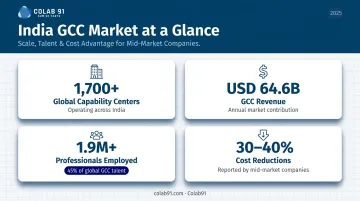
India's talent market is deep. According to a Zinnov-NASSCOM report, India now hosts over 1,700 Global Capability Centers, generates approximately USD 64.6 billion in GCC revenue, and employs 1.9 million+ professionals - nearly 45% of the global GCC talent base.
Mid-market companies in sectors like BFSI, retail, and manufacturing report 30–40% cost reductions through Indian GCCs.
The companies extracting the most value aren't treating offshore teams as cost centers. They're using them as strategic hubs, with responsibilities including:
- Running procurement analytics and spend visibility programs
- Managing supplier risk end-to-end
- Owning operational processes across functions
How to Build a High-Performing Offshore Team: Step-by-Step
Step 1: Define Your Scope and Operating Model
The most common first-year mistake is hiring before you've defined how the team will actually function. Without a clear operating model, you end up with capable people and no structural support to channel their work.
Before recruiting begins, answer these questions:
- What functions will be offshored? Be specific - not "procurement support" but "supplier data management, RFP coordination, and spend category analysis"
- What decision-making authority will the offshore team have? Can they approve vendor selections? Run negotiations independently? Or are they always supporting onshore leads?
- How will the offshore team integrate day-to-day? Which meetings do they attend? Who do they report to? What systems will they use?
- What does success look like at 6, 12, and 24 months? Define KPIs before hiring, not after
Key operating model decisions:
- Dedicated team vs. shared services center
- Managed model (partner manages operations) vs. self-managed, where you own all operations directly
- Build in-house vs. partner with a specialist capability center provider
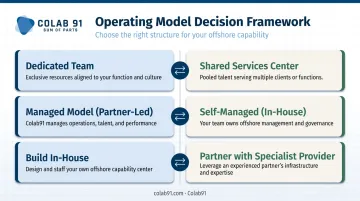
For mid-market companies with limited offshore experience, partnering with a firm that has already built and scaled these operations compresses the learning curve by months, not weeks.
Colab91's leadership built Impendi's India operations from scratch to 100+ practitioners, serving firms like Carlyle Group, TPG, and BC Partners. That operational depth is what distinguishes a fast, functional build from a costly 18-month experiment.
Step 2: Choose the Right Location and Talent Market
Not every offshore location suits every function. Evaluate locations across five criteria:
- Talent pool depth in your specific domain (not just general graduates)
- English proficiency - India scores 490 on the EF English Proficiency Index, above the global average of 477, with Bengaluru scoring 559
- Time zone compatibility with your onshore team's working hours
- Labor cost differential relative to your home market
- Legal and regulatory environment for IP protection and employment
For procurement, analytics, and operations functions, India - particularly Gurugram (NCR) and Bengaluru - offers a combination of domain expertise, established delivery infrastructure, and talent supply depth that few other markets match. Gurugram's proximity to major enterprise clients and its dense concentration of sourcing and analytics talent makes it a natural anchor for mid-market builds. Colab91 operates from Gurugram for exactly these reasons.
Step 3: Define Roles, Hiring Criteria, and Team Structure
Translate your business objectives into a specific team structure before posting a single job description.
Define clearly:
- Which roles require deep domain expertise vs. which can be trained
- The seniority mix (a common mistake is hiring all analysts with no senior lead)
- What "good" looks like for each role - not just credentials, but work outputs
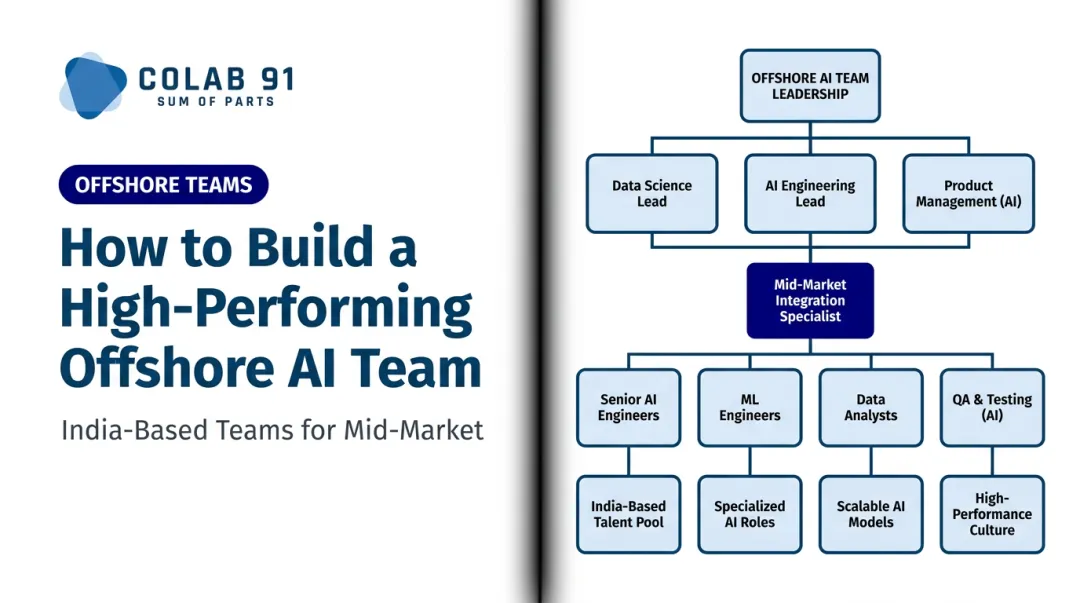
The anchor hire is your most important early decision. Your local team lead should manage day-to-day operations independently, represent your culture to new hires, and reduce dependence on onshore management bandwidth. This person is your operational backbone in-country, not just a senior individual contributor.
Without a strong anchor hire, onshore leadership ends up managing logistics instead of strategy - which is how offshore builds lose momentum in year one.
Step 4: Establish Legal, Compliance, and Security Foundations
This phase gets skipped or rushed more often than any other - typically under pressure to move fast. The downstream cost of that shortcut is consistently higher than the time it saves.
Non-negotiables before your first hire:
- Legal entity or employer-of-record (EOR) setup - determines how employees are engaged, taxed, and protected
- IP ownership and NDAs - critical for knowledge-work functions; don't assume standard employment contracts cover this
- Data security protocols - especially for analytics and procurement functions handling sensitive supplier or financial data
- Local employment law compliance - 81% of GCC survey respondents cited transfer pricing as a top regulatory priority, with 67% citing SEZ/STPI regulations and 60% citing labor-law compliance
Companies that invest two to three weeks here avoid the kind of legal and compliance exposure that can stall operations for months later.
Step 5: Run a Structured Recruitment and Vetting Process
Accessing top-tier offshore talent requires more than posting on job boards. The best procurement and analytics professionals in Gurugram or Bengaluru have multiple options - your hiring process and employer brand need to compete.
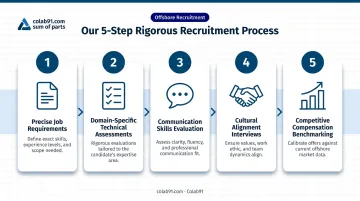
A rigorous vetting process includes:
- Precise job requirements - not generic descriptions, but specific work outputs and domain scenarios
- Domain-specific technical assessments - test actual procurement or analytics skills, not just credentials
- Communication skills evaluation - structured interview rounds that assess written and verbal English in realistic work contexts
- Cultural alignment interviews - include onshore stakeholders in final rounds so both sides calibrate fit before the hire is made
- Competitive compensation benchmarking - understand local market rates; underpaying relative to peer organizations is a direct predictor of early attrition
Onboarding and Integrating Your Offshore Team
The Critical 30 Days Before Your First Hire Joins
Most offshore retention problems are created before the new hire's first day. The pre-onboarding period shapes an offshore employee's long-term engagement more than any single management decision after they join.
Preparation checklist:
- Appoint an internal onshore champion who owns the offshore program - not just an administrator, but someone invested in the team's success
- Build documentation and process guides in advance - don't leave new hires waiting for context
- Set up system access, communication tools, and project management accounts before day one
- Communicate clearly to onshore team members that the offshore role is additive, not a threat to their positions
First week structure matters. Don't leave offshore hires in a passive orientation period. Share company vision and values directly. Introduce them to the full team via video calls. Assign a meaningful first project with clear success criteria. The message should be: you're a colleague from day one, not a contractor being evaluated.
Building Integration Between Onshore and Offshore Teams
Integration doesn't happen by default. You have to design it.
Practical mechanics that work:
- Reserve 2-3 hours of daily overlap for live collaboration, regardless of time zone differences
- Include offshore members in the same all-hands meetings - not a separate briefing, the same call
- Use shared project management tools (Jira, Asana, or similar) so everyone has equal visibility
- Define clear escalation paths with a response SLA - offshore team members need to know who to call when they hit a blocker, and how fast to expect an answer
The structural mechanics above address logistics. The cultural dimension is where most companies underinvest - and where the real retention risk lives.
Cross-cultural communication training for onshore managers produces faster results than most teams expect. Virtual coffee chats and team recognition moments sound minor. Over time, they compound into measurable retention gains. Offshore team members who feel like full colleagues consistently outperform those who feel like a separate unit - and they stay longer.
The risk of getting this wrong is concrete: teams that treat offshore members as a distinct operational layer typically see higher attrition, slower ramp times, and a two-tier dynamic that quietly limits what the team can deliver.
Managing an Offshore Team for Long-Term Performance
Communication and Accountability Rhythms
High-performing offshore teams operate on a defined cadence - not ad hoc communication, not over-meeting. Both failure modes are common.
Recommended operating rhythm:
- Daily async standups - task visibility, blockers flagged, no live meeting required
- Weekly syncs - priorities, decisions, and unresolved issues; 30-45 minutes maximum
- Monthly performance reviews - KPI tracking tied to business outcomes, not just task lists
- Quarterly strategic check-ins - connect offshore team's work to company goals; this is what keeps offshore talent engaged long-term
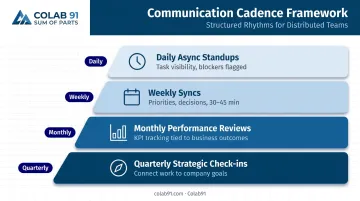
Tools like Slack, Jira, Asana, and Microsoft Teams support this rhythm - but they don't create it. The operating cadence must be owned jointly by onshore managers and offshore team leads. When onshore ownership fades (usually around month four or five, once the initial setup energy dissipates), performance degrades quickly.
Performance Management and Continuous Development
Distinguish between output and outcome metrics:
| Output Metrics | Outcome Metrics |
|---|---|
| Deliverables completed | Cost savings delivered |
| Turnaround times | Process improvement rate |
| Quality scores | Spend under management |
| Task completion rate | Business value created |
Offshore teams tied to outcome metrics - not just task completion - develop differently. They understand the business context for their work, ask better questions, and retain longer.
That context dependency makes development investment non-negotiable. Korn Ferry found that lack of career growth and perceived pay inequity are the primary voluntary attrition drivers in India. With India's overall attrition running at 16.2% in 2025, losing a trained domain expert mid-program - then recruiting, onboarding, and ramping a replacement - costs materially more than structured career pathing does.
Give offshore team members exposure to onshore strategy conversations, not just execution tasks. Clear progression paths and visible growth opportunities are what keep high performers from leaving once they're fully productive.
Common Mistakes Companies Make When Building Offshore Teams
Most offshore programs don't fail because of geography or talent supply. They fail because of predictable, avoidable decisions made before the first hire.
Treating offshore as a stopgap, not a strategy. Companies that offshore to solve an immediate problem - a backlog, a budget cut - without a long-term plan underinvest in onboarding, governance, and culture. The result is a team that churns within 12-18 months and never reaches productivity. Fewer than 10% of GCCs have reached top-tier maturity states, according to Everest Group - and the primary reason is the absence of a long-term capability-building commitment from the start. Commit to a 3-5 year horizon before you hire the first person.
Hiring for cost over capability. Offshore talent quality varies significantly. The cheapest option rarely delivers the domain fit, communication quality, or cultural alignment that mid-market and PE-backed companies need within tight transformation timelines. If your offshore team can't independently own a category analysis or a supplier negotiation within 90 days, you've hired for the wrong variable - and you'll pay for it in rework, turnover, and lost time.
Underinvesting in onshore management bandwidth. Offshore teams don't run themselves. Without a dedicated onshore owner who communicates context regularly, resolves blockers quickly, and champions the program internally, even well-hired teams will underperform.
This is the most common - and most preventable - failure point. Before building offshore, confirm that someone onshore owns this role. If that person doesn't exist, the program won't reach its potential regardless of how strong the offshore hires are.
Frequently Asked Questions
What does "offshore team" mean?
An offshore team is a group of professionals in another country who work as an integrated extension of your company - attending your meetings, using your systems, and reporting to your managers. Unlike outsourcing, where a vendor operates independently, offshore team members function as direct colleagues.
How do you work with offshore teams effectively?
Establish defined communication rhythms (daily async updates, weekly syncs) and use shared project management tools for full visibility. Invest in cultural integration and treat offshore members as full colleagues with direct access to company goals, not as a separate operational layer.
What is the difference between offshore, nearshore, and onshore outsourcing?
Onshore keeps work in your home country. Nearshore places teams in adjacent time zones - such as US companies using Latin American teams - for easier real-time collaboration. Offshore uses geographically distant locations like India, offering the largest cost differential and talent pool depth. It requires more deliberate communication design, but the tradeoffs are typically worth it.
How do you manage an offshore team across time zones?
Schedule 2-3 hours of daily overlap for live collaboration. Use async tools (Slack, Loom, written standups) for non-urgent communication. Maintain clear documentation so offshore team members can work independently without waiting for onshore input on every decision.
What are the biggest mistakes companies make when building an offshore team?
The top three: treating offshore as a short-term cost fix rather than a strategic capability build, hiring for price over domain fit and communication quality, and underinvesting in onshore management ownership and cultural integration. All three are avoidable with upfront planning.